
Marketing a consumer app is often about volume: get as many downloads as possible and convert a share of them into paying users. Marketing a B2B mobile app is different. The person who downloads it may not be the person who pays for it, the company may need IT approval before anyone can use it, and success depends on whole teams adopting it, not just one curious employee.
Whether you’ve built a field service app, a sales enablement tool, an inspection app or a mobile companion to your SaaS platform, the goal is the same: get the right businesses to try it, and get their teams to keep using it. Here’s how our team thinks about it.
Know who buys and who uses
Start by separating your audiences. In most B2B apps there are at least three:
- The buyer, such as an operations director or IT manager, who cares about cost, security, integrations and return on investment.
- The admin, who sets up accounts, permissions and integrations.
- The end user, such as a technician, sales rep or nurse, who needs the app to be fast and easy on the job.
Each group needs different messages. The buyer wants a business case. The admin wants clear setup documentation. The end user wants to see that the app makes their day easier. Marketing that only speaks to one of these groups usually stalls.
Lead with the website, not the app store
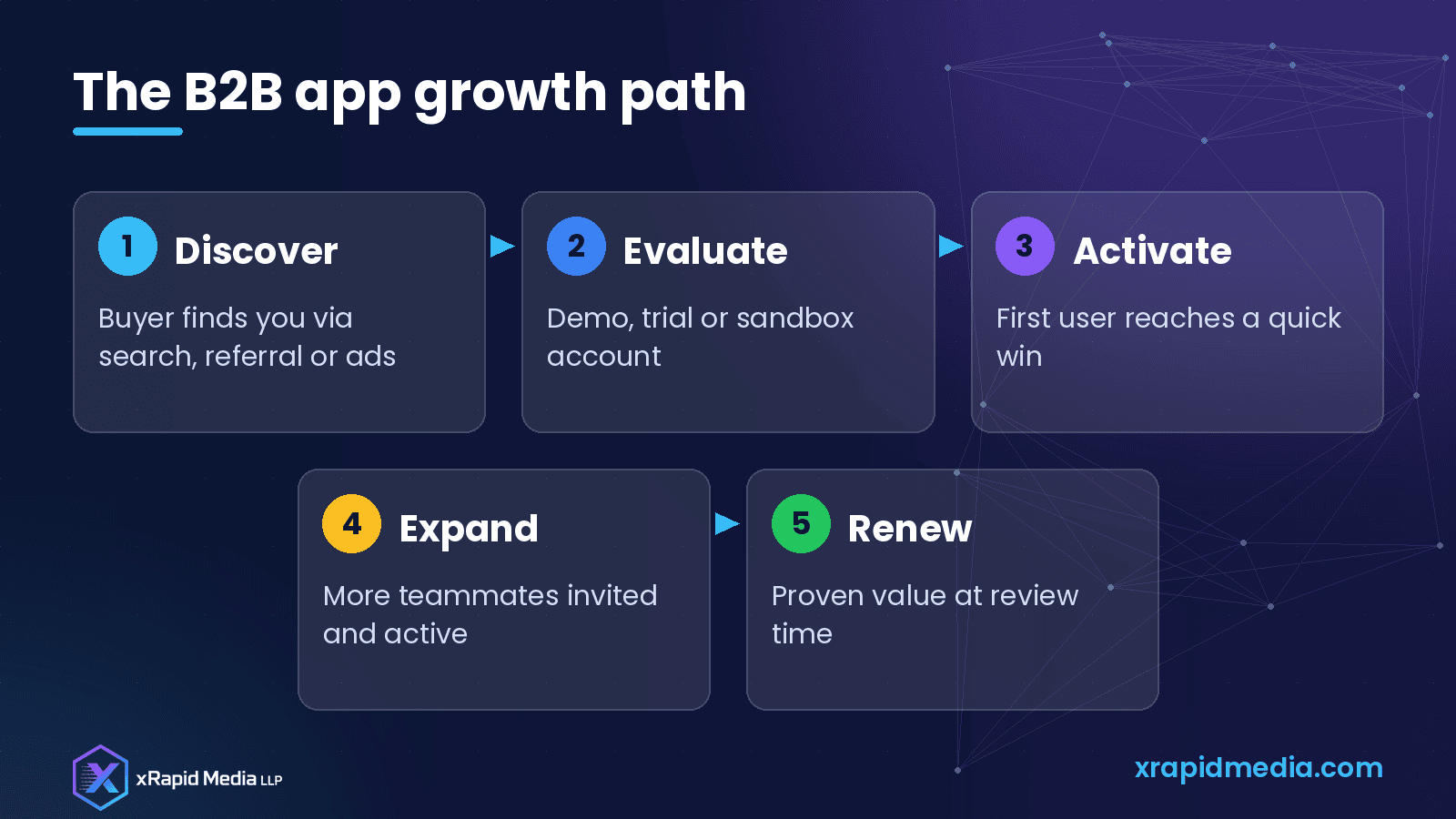
Consumer apps live and die in app stores. B2B apps are usually discovered through search, referrals, industry events and content, and evaluated on your website.
Your website should make it easy to understand:
- What problem the app solves and for which industries or roles.
- How it works, ideally with short screen recordings rather than just static screenshots.
- What it connects to, such as your web platform, CRM or other business systems.
- How security and device management are handled.
- How to get started, whether that’s a free trial, a demo or a pilot.
App store listings still matter, especially for credibility and for end users who search for the app after their company signs up. Keep them accurate and consistent with your website, but don’t rely on them to sell to businesses.
Offer a low-risk way to try it
Businesses are cautious about rolling out new tools. Reduce the risk with options like:
- A free trial with sample data so people can explore without setting anything up.
- A sandbox or demo account for evaluators.
- A small pilot with one team for a fixed period, with clear success criteria agreed in advance.
Pilots are especially effective for B2B apps because they create internal champions. When a field team lead sees their crew finishing jobs faster, they’ll argue for a wider rollout.
Make the first experience count
In B2B, onboarding is marketing. If the first user can’t get value quickly, they won’t invite teammates and the deal may never expand.
Design onboarding around a quick win. For an inspection app, that might be completing and sharing a first report. For a sales app, it might be logging a first customer visit with notes and photos. Use short in-app tips, a welcome email that links to one key task and an easy way to invite colleagues.
Push notifications and emails should support this journey, not interrupt it. Send reminders tied to useful actions rather than generic “we miss you” messages.
Turn usage into expansion
Most B2B app revenue grows after the first sale, as more users or teams come on board. Help that happen by:
- Showing admins simple usage reports so they can see adoption and value.
- Making it easy to add users and teams without a long sales process.
- Sharing short success stories from similar customers, with their permission.
- Checking in with champions before renewal to understand what’s working and what isn’t.
Customer success and marketing should work closely here. The best expansion content often comes from real customer conversations.
Use account-based tactics for bigger deals
If your app is aimed at mid-sized or enterprise companies, treat key prospects as accounts rather than individual leads. Identify the buyer, admin and likely champions at each company, and tailor content to each. A case study for the operations director, a security overview for IT and a short demo video for team leads can all support the same deal.
Measure what matters
Downloads are a vanity number in B2B. More useful measures include:
- Trials or pilots started by companies that fit your target profile.
- Activation, meaning the share of new accounts that complete the key first task.
- Active users per account over time.
- Expansion from one team to several.
- Renewal and churn.
These numbers tell you whether your marketing is bringing in the right companies and whether your onboarding is turning them into long-term customers.
Wrapping up
Marketing a B2B mobile app means winning over buyers, admins and everyday users, each with different needs. Use your website to explain the value, offer a low-risk way to try it, make the first experience count and support expansion inside each account. Do that consistently, and downloads become something much more valuable: teams that rely on your app every day.
About xRapid Media
xRapid Media LLP is a High Tech B2B Marketing company for technology businesses: software and SaaS companies, IT services and managed service providers, and hardware and IT product vendors. Our team combines positioning and content, account-based marketing, paid ads funnels, verified B2B data, intent signals, email and LinkedIn outreach and appointment setting to help you reach the right buyers and turn their attention into qualified leads and meetings.
Want help putting ideas like these into practice? Email [email protected] or book a time with our team.