

Many early-stage B2B tech startups have a go-to-market plan that lives in the founder’s head. Others have the opposite problem: a long strategy document written for investors that nobody on the team opens again.
What a small team actually needs is one page. A single, clear plan that says who you are selling to, what you are saying, how you will reach them and how you will know it is working. It should be short enough to review in a weekly meeting and specific enough to guide decisions.
Our team at xRapid Media LLP, a High Tech B2B Marketing company, helps startups in software, SaaS, IT services and hardware turn early traction into a repeatable pipeline. Here is the template we use, section by section.
1. Customer: who you sell to first
Name one primary segment. Not “mid-market companies,” but something more like “US-based logistics companies with 50 to 500 employees and their own dispatch team.” Include:
- Industry and company size.
- The job titles of the person who feels the problem and the person who signs off.
- Any trigger that makes them more likely to buy, such as a new regulation, rapid hiring or an aging system.
You can add more segments later. Starting with one keeps your message and outreach focused.
2. Problem: what hurts and why now
Write two or three sentences describing the problem in your customer’s language. Use phrases you have heard in real conversations, not internal jargon. Then add why it matters now. Buyers postpone problems that feel permanent, and act on ones with a deadline or a growing cost.
3. Message: one sentence they remember
Summarize what you do and why it matters in one sentence. A useful format is: “We help [customer] [achieve outcome] without [common pain].” Add three short proof points underneath, using only facts you can back up, such as early customer results they are happy to share, notable integrations or your team’s relevant experience.
4. Channels: two or three ways to reach them
Most startups spread too thin. Pick two or three channels that match how your customer buys:
- Outbound email and phone to a well-defined list, for buyers who rarely search for solutions.
- Content and search, for problems people actively research.
- Partnerships with companies already serving your customer.
- Events or communities where your customer gathers.
For each, note what you will do this quarter and who owns it.
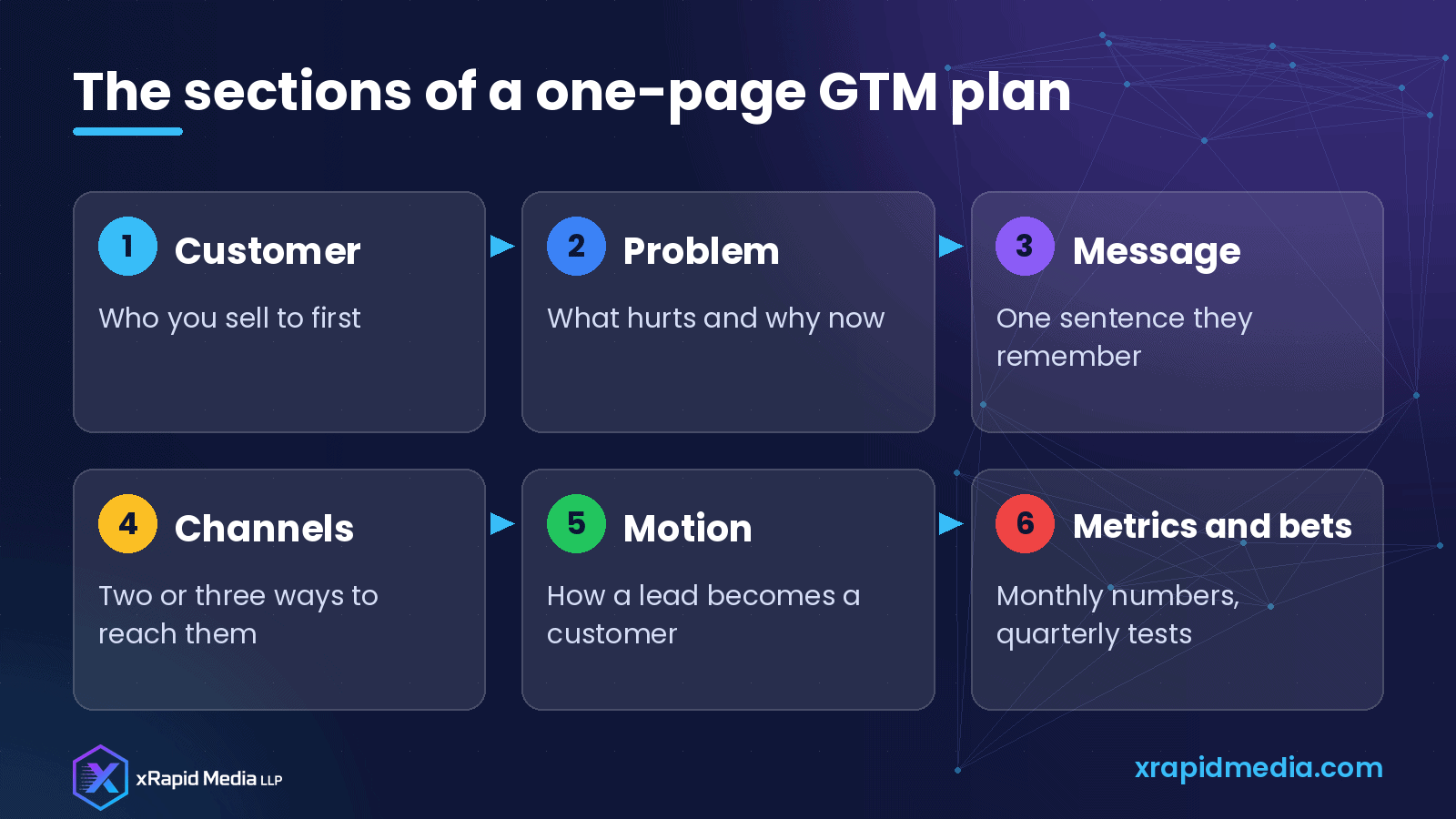
5. Motion: how a lead becomes a customer
Describe the path from first contact to signed deal in a few steps. For example: outbound email, discovery call, technical demo, pilot, contract. Note who handles each step and roughly how long it takes. Writing this down reveals gaps, such as no clear owner for follow-up after demos or no standard pilot terms.
If you have a self-serve product, describe that path instead, including where a salesperson steps in.
6. Metrics: numbers you review every month
Choose a small set of numbers and review them on a regular rhythm:
- New qualified conversations or meetings per month.
- Conversion from meeting to pilot or proposal.
- Deals won and average deal size.
- Time from first meeting to close.
- One leading indicator per channel, such as reply rate for outbound or demo requests from content.
Avoid vanity metrics. Website visits and social followers can be useful context, but they do not belong at the center of an early-stage plan.
7. Bets: experiments for this quarter
List two or three specific experiments, each with a hypothesis, a time frame and a way to judge it. For example: “If we target operations managers instead of IT managers in logistics companies, we will book more discovery calls from the same outreach volume. Test over six weeks.”
This section keeps the plan alive. At the end of each quarter, record what you learned and decide what to keep, change or stop.
How to use the plan
A one-page plan is only useful if the team uses it:
- Review it briefly in a weekly meeting, focusing on metrics and experiments.
- Update it fully each quarter, or sooner if you learn something important.
- Share it with new hires, advisors and agency partners so everyone works from the same picture.
- Keep old versions. Seeing how your plan evolved is helpful when you raise funding or hire a marketing leader.
Common mistakes to avoid
- Choosing several customer segments at once and diluting every message.
- Listing every possible channel instead of committing to a few.
- Writing a message that describes features rather than the customer’s problem.
- Tracking numbers but never making decisions based on them.
Conclusion
A one-page go-to-market plan gives an early-stage B2B tech startup focus and a shared language. Define your first customer, describe the problem and message clearly, commit to a few channels, map your sales motion, track a handful of metrics and run deliberate experiments. Then revisit it often.
If you want help building and running a go-to-market plan that produces qualified meetings, book a free B2B marketing consultation with xRapid Media LLP.
About xRapid Media
xRapid Media LLP is a High Tech B2B Marketing company for technology businesses: software and SaaS companies, IT services and managed service providers, and hardware and IT product vendors. Our team combines positioning and content, account-based marketing, paid ads funnels, verified B2B data, intent signals, email and LinkedIn outreach and appointment setting to help you reach the right buyers and turn their attention into qualified leads and meetings.
Want help putting ideas like these into practice? Email [email protected] or book a time with our team.