
Most productivity software companies offer both monthly and annual billing, with a discount for paying yearly. On paper, the choice is easy for customers who plan to stay. In practice, a large share of teams sign up monthly and never revisit it. Nobody on their side has a reason to think about billing, and nobody on your side has given them one.
That leaves value on the table for both sides. Annual plans give you more predictable revenue and fewer cancellations from teams that drift away. Customers who are committed to your tool save money and avoid monthly charges that can trigger questions from finance.
Our team at xRapid Media LLP, a High Tech B2B Marketing company, helps SaaS and productivity software companies run lifecycle campaigns like this. Here is how to move monthly customers to annual plans without feeling pushy.
Pick the right accounts
Not every monthly customer is a good candidate. Teams still evaluating your product, or with falling usage, may cancel rather than commit. Focus on accounts that already show they rely on you:
- Steady or growing active users over the last two or three months.
- Regular use of core features, not just occasional logins.
- Several team members collaborating, rather than a single user.
- No open billing disputes or unresolved support issues.
Your product analytics and billing data together can produce this list. Review it with customer success to remove accounts they know are at risk.
Time the ask after value, not at signup
Many products push the annual plan hardest during signup, when the buyer knows the least about your product. That works for some customers, but the bigger opportunity is later, when value is visible.
Good moments to make the case include:
- After the team hits a milestone, such as a set number of projects completed or documents shared.
- When an admin adds new seats, showing the team is growing.
- Ahead of the customer’s budget planning period, if you know it.
- After a positive customer success review.
Avoid moments of friction, such as right after a support issue or a price change.
Make the annual benefit clear and concrete
Customers need a simple reason to switch. Spell out:
- The savings: show the actual amount for their current number of seats, not just a percentage.
- The convenience: one invoice a year, fewer monthly approvals and easier budgeting.
- Any extra value: priority support, onboarding sessions for new team members or admin features, if these come with annual plans.
- Flexibility: how adding seats mid-year works, so they do not feel locked in at a size they will outgrow.
Be transparent about terms, including what happens at renewal and how cancellations work. Surprises at renewal damage trust and lead to churn the following year.
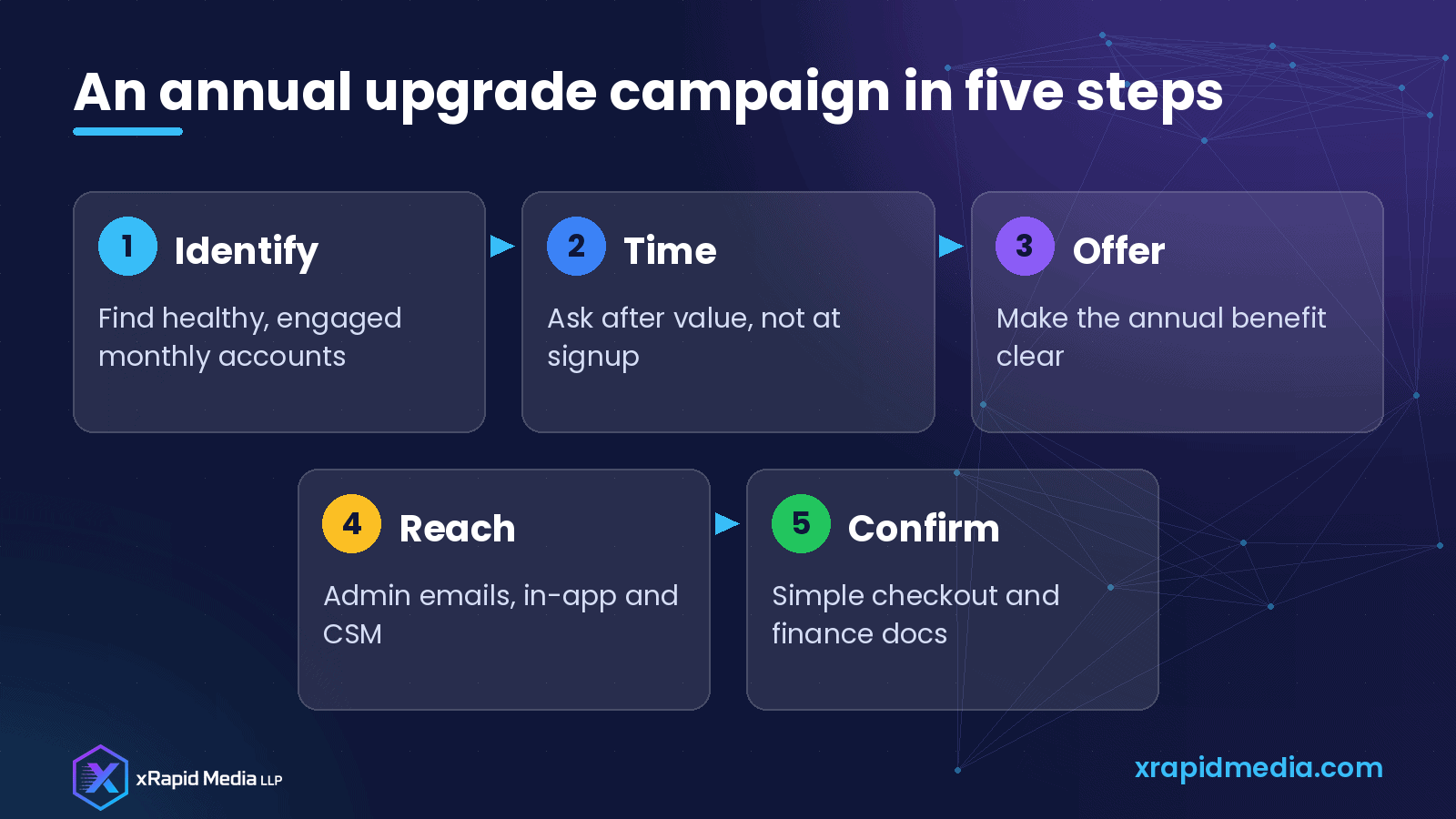
Reach admins through several channels
The person who decides on billing is usually an account admin or owner, sometimes with someone in finance. Reach them in ways that fit their role:
- Email: a short, personal message from the account manager or customer success contact, showing their savings and offering to answer questions.
- In-app messages: a banner or note in the billing or admin area, not a pop-up interrupting everyday users.
- Customer success conversations: for larger accounts, include the annual option in business reviews alongside usage highlights.
- Finance-friendly materials: a one-page summary with pricing, payment options and security or vendor documentation they may need.
Limit the number of reminders. Two or three well-timed touches usually work better than a long sequence.
Remove friction at checkout
When a customer decides to switch, make it effortless:
- A one-click upgrade in the billing settings for self-serve accounts.
- Prorated credit for the remaining monthly period, clearly explained.
- Support for invoices and purchase orders for companies that need them.
- Quick answers to vendor onboarding forms and tax documents.
Every extra step creates a chance for the decision to stall in someone’s inbox.
Combine upgrades with expansion
An annual conversation is also a natural time to discuss growth. If a team is likely to add users or move to a higher plan, show the combined option. Keep the focus on what helps the customer. Pushing an expensive bundle in an upgrade email can make the whole offer feel like a sales tactic.
Measure results honestly
Track how many targeted accounts switch to annual, the revenue impact and, importantly, retention at renewal compared with similar accounts that stayed monthly. Watch for warning signs, such as support tickets about unexpected charges, which suggest the terms were not clear enough.
Test variables one at a time: timing, offer framing, channel and messenger. Small changes, such as showing the dollar savings instead of a percentage, can make a noticeable difference.
Conclusion
Many monthly customers would happily commit for a year if someone made a clear, well-timed case. Pick healthy accounts, ask after they have seen value, make the benefits concrete, reach admins through the right channels and remove friction at checkout. The result is steadier revenue for you and a better deal for customers who already rely on your product.
If you want help planning lifecycle and expansion campaigns for your software product, book a free B2B marketing consultation with xRapid Media LLP.
About xRapid Media
xRapid Media LLP is a High Tech B2B Marketing company for technology businesses: software and SaaS companies, IT services and managed service providers, and hardware and IT product vendors. Our team combines positioning and content, account-based marketing, paid ads funnels, verified B2B data, intent signals, email and LinkedIn outreach and appointment setting to help you reach the right buyers and turn their attention into qualified leads and meetings.
Want help putting ideas like these into practice? Email [email protected] or book a time with our team.