
When a B2B tech company plans a new website, the platform debate often starts in engineering. Developers like headless architectures because they can use modern frameworks, deploy like any other app and keep the front end fast. Marketers often prefer traditional platforms such as WordPress because they can build and change pages themselves.
Both camps have a point. The wrong choice usually is not “headless” or “traditional.” It is a platform that does not match how your team actually works. Our team at xRapid Media LLP, a High Tech B2B Marketing company, has seen beautifully engineered sites that could not launch a webinar page without a sprint ticket, and easy-to-edit sites that slowed to a crawl under plugins. Here is how we help software, SaaS and IT companies make the call.
What the two approaches really mean
A traditional CMS manages both content and presentation. Editors write in the same system that renders the pages, usually with themes, templates and a visual block editor. WordPress is the best-known example.
A headless CMS stores and manages content but does not render the website. Developers build the front end separately and pull content through an API. The same content can feed a website, an app, documentation or a partner portal.
There are also hybrid setups, such as traditional platforms used headlessly or headless platforms with visual page builders. The labels matter less than the day-to-day workflow they create.
Question 1: Who will build pages?
This is the most important question. Think about the last ten pages your marketing team needed: campaign landing pages, event pages, case studies and comparison pages.
- If marketers built most of them without help, they need a platform with flexible templates and a visual editor they trust.
- If developers built most of them anyway, a headless setup may cost little in independence.
- If the answer is “we waited weeks for most of them,” the platform is already holding back demand generation.
With headless, budget time for developers to build a library of reusable page sections that marketers can assemble. Without that library, every campaign becomes a development request.
Question 2: How often do you launch?
A company that runs a webinar every month, launches new campaign pages every week and tests offers regularly needs speed above all. A company that updates a few product pages each quarter can tolerate a slower workflow in exchange for engineering control.
Be honest about your plans, not just your current pace. If you intend to scale paid campaigns or account-based marketing, you will need many more landing pages than you do today.
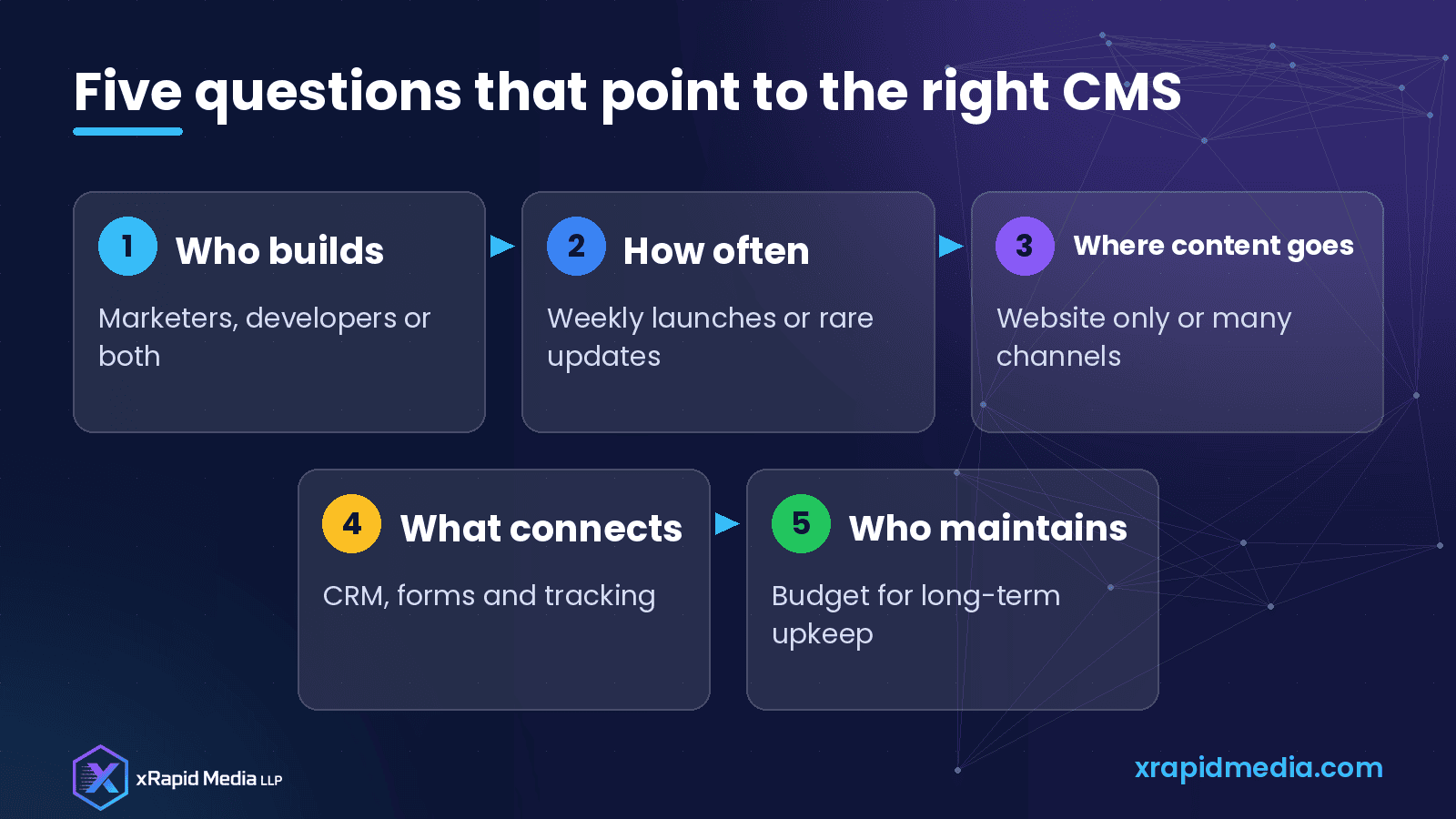
Question 3: Where does your content need to go?
Headless shines when the same content has several destinations. A cloud or developer tools company might publish documentation, changelogs, integration listings and blog posts that appear on the website, inside the product and in a developer portal. Managing that content once and delivering it everywhere saves real effort.
If your content mostly lives on the marketing website, that advantage shrinks, and the simplicity of a traditional CMS often wins.
Question 4: What needs to connect?
A B2B website is a lead engine, so the integrations matter as much as the design. Before choosing, list what has to work on day one:
- Forms that send leads into your CRM or marketing automation with the right source fields.
- Analytics and tag management, including conversion tracking for ad platforms.
- Chat, scheduling and meeting booking tools.
- Personalization or account identification tools, if you use them.
- Consent management for privacy rules in the places you sell.
Traditional platforms often have ready-made plugins for these. Headless sites can integrate with anything, but each integration is code your team owns. Neither is wrong, but the effort should be planned and budgeted.
Question 5: Who maintains it in two years?
Websites outlive the people who built them. Ask who will handle updates, security patches, hosting and fixes after launch.
- A traditional CMS needs regular plugin, theme and core updates, plus careful plugin choices to avoid bloat and security risk.
- A headless site needs developers comfortable with its framework and hosting setup. If your agency or lead developer leaves, can someone else pick it up quickly?
Choose the option you can realistically support, not the one that looks best in the launch announcement.
Common setups we see working
- Early-stage SaaS with a small team: a traditional CMS with a well-built theme and a tight set of plugins, so marketers can move fast.
- Developer-focused cloud or DevOps company: a headless CMS for docs and product content, with a page builder or component library so marketing can still ship landing pages.
- IT services firm or MSP: a traditional CMS with strong templates for service pages, location pages and case studies.
- Hardware vendor with large product catalogs: often a hybrid, with product data from a central system and marketing pages built in a CMS editors can manage.
Before you migrate
If you are changing platforms, protect what you already have. Inventory every page and form, map redirects for all old URLs and test lead capture before launch. A new platform that loses search rankings or breaks form routing can cost more pipeline than the old one ever did.
Conclusion
The best CMS for a B2B tech company is the one that lets your team publish the pages buyers need, capture leads reliably and stay secure over time. Start with who builds pages, how often you launch, where content goes, what must connect and who will maintain it. The answers usually make the choice clear.
If you want help planning a website that turns technology buyers into qualified leads, book a free B2B marketing consultation with xRapid Media LLP.
About xRapid Media
xRapid Media LLP is a High Tech B2B Marketing company for technology businesses: software and SaaS companies, IT services and managed service providers, and hardware and IT product vendors. Our team combines positioning and content, account-based marketing, paid ads funnels, verified B2B data, intent signals, email and LinkedIn outreach and appointment setting to help you reach the right buyers and turn their attention into qualified leads and meetings.
Want help putting ideas like these into practice? Email [email protected] or book a time with our team.