
B2B mobile apps have a quiet advantage that many teams never use. The people who rely on them every day, such as field technicians, sales reps, warehouse staff and site managers, often have strong opinions about what makes their work easier. When the app genuinely helps, many of them would happily say so. They just are not asked, or they are asked at the wrong time.
Meanwhile, the buyers evaluating your app look for proof: store ratings, peer recommendations and stories from companies like theirs. Our team at xRapid Media LLP, a High Tech B2B Marketing company, helps mobile and SaaS companies close that gap. Here is a practical way to turn satisfied users into advocates without nagging anyone.
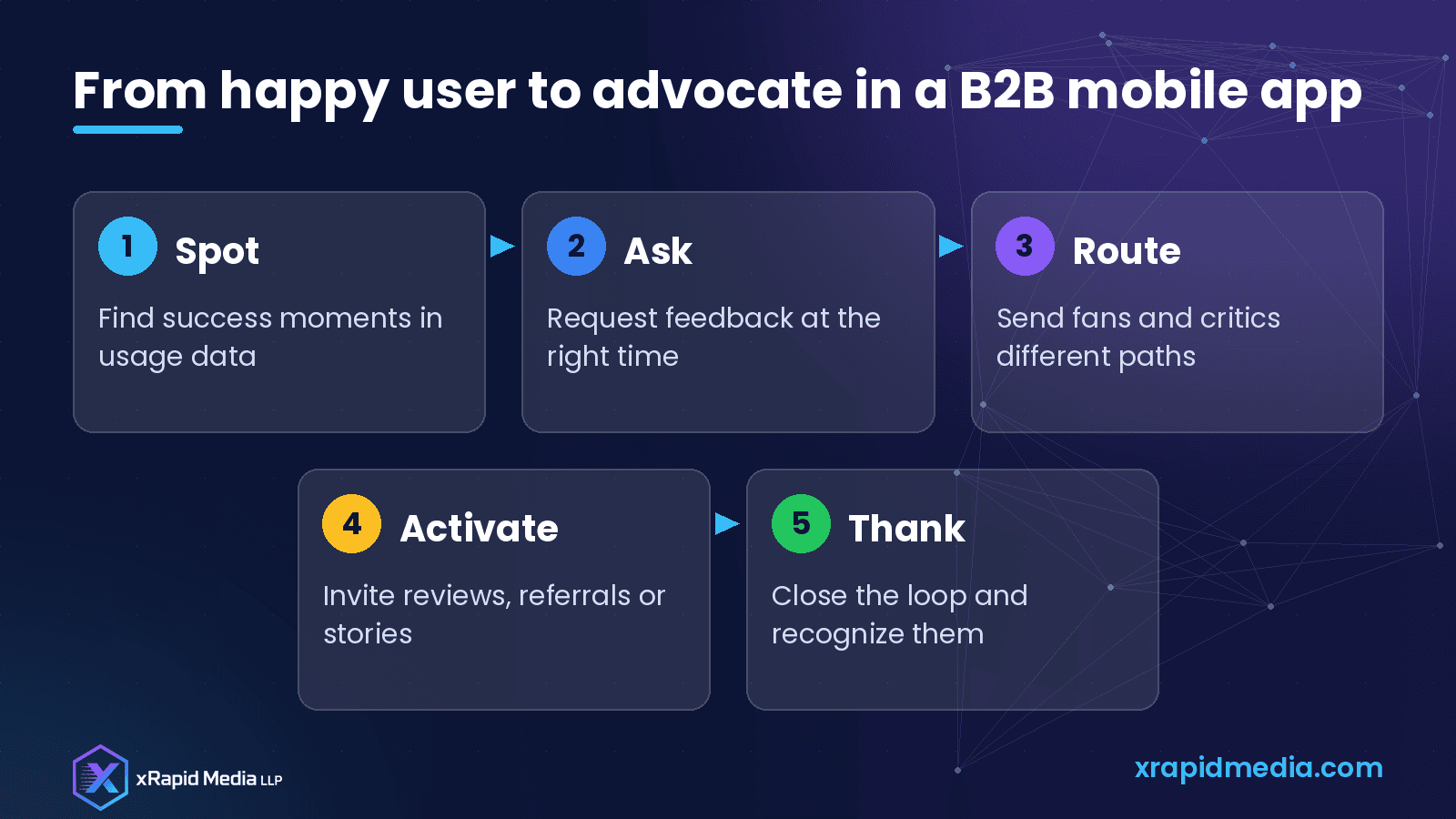
Start by finding success moments
Advocacy works best right after a user experiences value. In a B2B app, these moments are usually visible in your product data:
- A technician closes a set number of jobs entirely from the app.
- A sales rep submits an order offline and it syncs without issues.
- A manager approves requests in seconds instead of waiting until they are back at a desk.
- A team completes its first full month using the app daily.
Work with your product team to define three or four of these moments. They become the triggers for everything that follows.
Ask for feedback before asking for praise
Jumping straight to “Rate us five stars” feels pushy, and both major app stores have rules about how review prompts may be used. A better first step is a simple, neutral question at a success moment, such as “How is the app working for you so far?” with a short scale or thumbs up and down.
This does two things. It gives you useful signals, and it tells you who is likely to be an advocate and who needs help first.
Route fans and critics differently
Once someone answers, send them down different paths:
- Happy users can be invited to leave a store review, using the platform’s official review prompt where available.
- Neutral users can be asked what one thing would make the app more useful, which gives your product team ideas.
- Unhappy users should reach a person quickly, through in-app support, chat or a call from customer success. Fixing their problem matters more than any rating.
Never hide the option to give honest feedback, and never offer incentives in exchange for positive reviews. Beyond store policy issues, buyers trust ratings less when they look managed.
Turn champions into referrals
Some users go further than liking the app. They train new colleagues, request features and defend the tool in internal meetings. These champions are valuable for referrals because they often know peers at other companies in the same industry.
Ways to invite referrals that feel natural:
- Add a “Know another team that could use this?” option in the app’s settings or help menu, with a simple form.
- Mention referrals in customer success check-ins with admins who have seen strong adoption.
- Offer something useful in return, such as extended support, early access to features or a credit, where your policies and contracts allow it.
Keep the process light. A referral that requires a long form or a call to explain usually never happens.
Build case studies from real usage
Case studies are the most powerful advocacy asset for B2B mobile apps because they show buyers how the app fits into real operations. Your usage data helps you pick the right candidates: look for accounts with strong adoption, a clear before-and-after story and a champion willing to talk.
A good mobile app case study usually covers:
- The work that happened before the app, such as paper forms, phone calls or desktop-only systems.
- How rollout went, including device management and training.
- What changed for frontline staff and for managers.
- Any results the customer is comfortable sharing, in their own words or numbers they have approved.
Short formats work well alongside the full story. A one-minute video of a technician using the app on site, or a quote from a field manager, can be used in sales decks, emails and app store screenshots.
Make advocacy part of the customer journey
Advocacy should not depend on one person remembering to ask. Build it into your customer success process:
- After onboarding: check satisfaction and fix early issues.
- After the first success moment: invite feedback and, for happy users, a review.
- At quarterly reviews with admins: discuss referrals and case study interest.
- At renewal: ask long-term champions if they would act as a reference for prospects.
Track who has been asked, what they agreed to and when, so you do not ask the same busy person too often.
Thank people properly
Advocates are doing you a favor. Close the loop by letting reviewers know when a feature they requested ships, sending case study participants the finished piece before it goes live and recognizing champions with their admins where appropriate. People who feel appreciated tend to advocate again.
Conclusion
B2B mobile apps already create moments where users feel the value. A simple advocacy program finds those moments, asks for honest feedback, routes fans and critics properly and turns the strongest champions into reviews, referrals and case studies. Over time, that proof does a lot of selling for you.
If you want help turning product success into pipeline for your B2B app, book a free B2B marketing consultation with xRapid Media LLP.
About xRapid Media
xRapid Media LLP is a High Tech B2B Marketing company for technology businesses: software and SaaS companies, IT services and managed service providers, and hardware and IT product vendors. Our team combines positioning and content, account-based marketing, paid ads funnels, verified B2B data, intent signals, email and LinkedIn outreach and appointment setting to help you reach the right buyers and turn their attention into qualified leads and meetings.
Want help putting ideas like these into practice? Email [email protected] or book a time with our team.