

Competitive intelligence in B2B tech used to mean a spreadsheet, a few browser tabs and a long afternoon. AI can compress that work, but it also introduces a new risk: confident summaries that are wrong. For marketers who brief sales, update comparison pages or plan campaigns, a made-up competitor claim is worse than having no brief at all.
Our team helps software, SaaS and IT services companies use AI for competitive research without treating the model as a source of truth. The model is a summarizer and organizer. Your sources still have to be real.
What competitive intelligence should answer
Before you open any tool, decide what you need. Most B2B tech teams care about a short list:
- How the competitor describes its product and who it sells to
- Pricing and packaging they publish (and what they keep opaque)
- Proof points they use: case studies, integrations, certifications
- Recent product announcements and positioning shifts
- How buyers talk about them in public reviews and forums
If you ask AI “Who is better, us or them?” you will get marketing fluff. If you ask it to extract claims from specific pages and label what is verified versus unknown, you get something sales can use.
Start with primary sources only
Feed the model material you collected yourself. Useful inputs include:
- Competitor homepage, product pages and pricing pages
- Official blogs, release notes and press releases
- Public SEC filings or investor decks when available
- Partner marketplace listings and integration directories
- Review sites where customers leave dated comments
- Job postings that reveal stack and hiring priorities
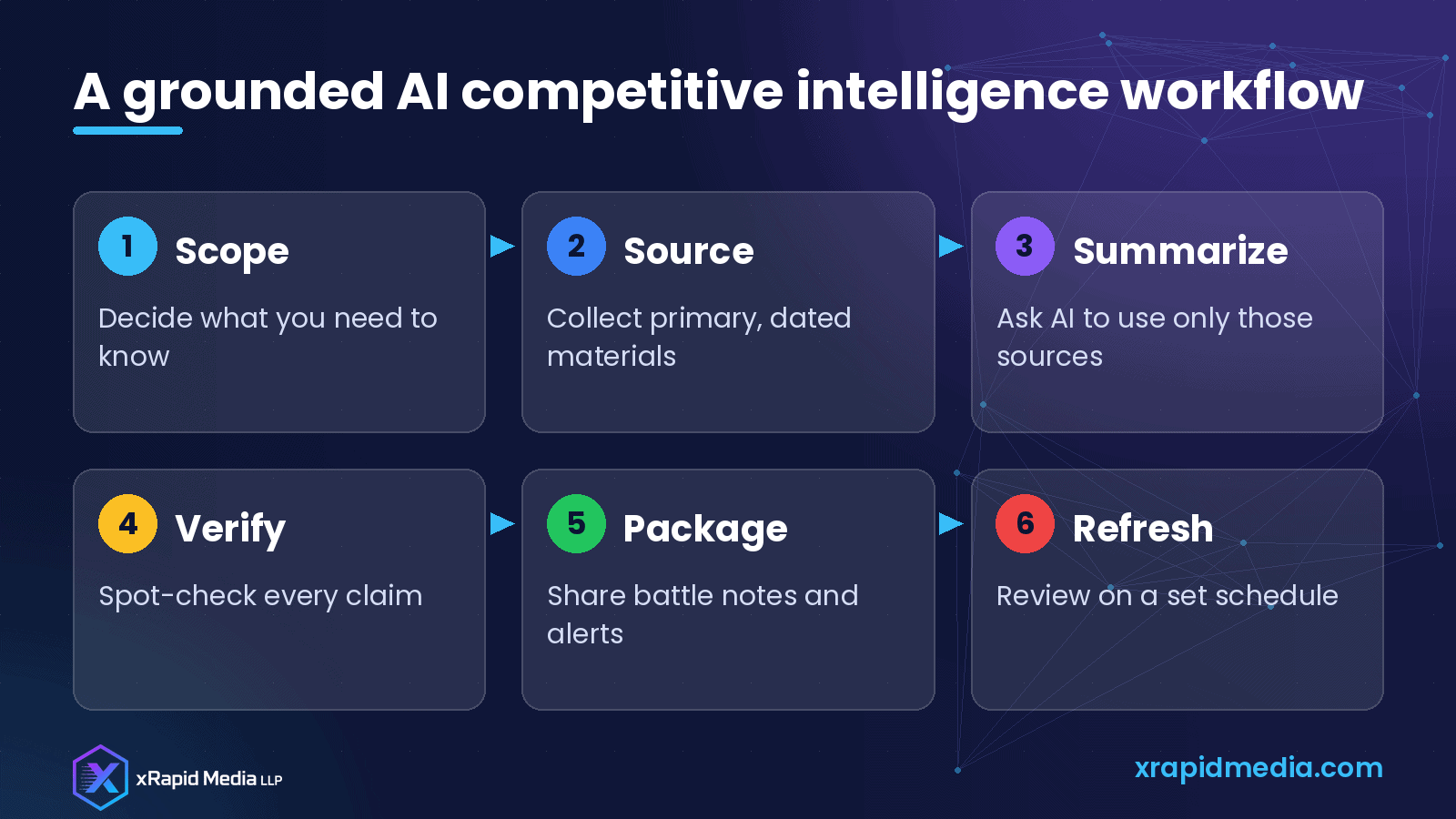
Save URLs and access dates. Tell the AI: use only the text provided, quote short phrases when claiming a feature, and mark anything missing as “not found in sources.” That single instruction removes most hallucinations.
Use AI for synthesis, not invention
Strong prompts look like process steps, not open-ended opinions:
- Extract positioning statements and target personas from these pages
- List pricing tiers and what is included, noting gaps
- Compare their stated integrations with our known stack
- Flag claims that appear marketing-heavy and lack proof
- Draft a one-page brief with citations back to your source snippets
Ask for a table or bullet brief, not a narrative that “sounds smart.” Narrative style is where models invent connective tissue.
Build a human verification layer
Someone on marketing or product marketing should spot-check every brief before it reaches sales. Check:
- Does each feature claim appear on a live page or release note?
- Is pricing current, or could it be outdated?
- Are customer logos still shown on their site?
- Did the model confuse two products with similar names?
When something cannot be verified, leave it out or label it “unconfirmed.” Sales trusts a short, honest brief more than a long one full of maybes.
Turn research into assets people open
Competitive intelligence fails when it lives in a private doc nobody reads. Package it as:
- A one-page battle card with “say this / don’t say that”
- A comparison outline for the website (facts only)
- A monthly “what changed” note for sales and CS
- Alerts when a competitor launches something that affects a live deal
Keep language plain. “They emphasize faster onboarding for mid-market IT teams” is useful. “They dominate the category” is not.
Guardrails that keep you out of trouble
Never invent market share, win rates or customer quotes. Never claim a competitor is insecure, failing or “dying” unless you have a public, attributable fact and a lawyer would be comfortable with it. Avoid scraping behind logins or using private data. Stick to public pages and material your company is allowed to use.
Also watch for stale AI memory. Models can recall outdated product names. Your attached sources should always override general knowledge.
A weekly rhythm that scales
Pick five priority competitors. Once a week, refresh their product, pricing and news pages, run the AI summary on the new captures, verify and send a short update. Once a quarter, do a deeper teardown for messaging and packaging. Assign an owner so the process does not depend on one person’s free time.
Where this fits in a wider marketing system
Competitive intelligence should feed content, ads, outbound and enablement. If buyers keep asking how you differ on security reviews, that belongs in a guide and a sales talk track. If a competitor cuts a mid-tier plan, your pricing page FAQ may need an update. AI speeds the reading. Your team still decides what to say in public.
Getting started this week
Choose one competitor. Capture five primary pages. Ask AI to produce a cited one-page brief with an “unknowns” section. Verify every line. Share it with two account executives and ask what is missing. Then expand to the rest of your set.
If you want help building a competitive program that pairs grounded research with messaging, content and outreach, our team at xRapid Media LLP works with B2B tech companies on exactly that. Book a free B2B marketing consultation and we can review your current approach together.
About xRapid Media
xRapid Media LLP is a High Tech B2B Marketing company for technology businesses: software and SaaS companies, IT services and managed service providers, and hardware and IT product vendors. Our team combines positioning and content, account-based marketing, paid ads funnels, verified B2B data, intent signals, email and LinkedIn outreach and appointment setting to help you reach the right buyers and turn their attention into qualified leads and meetings.
Want help putting ideas like these into practice? Email [email protected] or book a time with our team.