
Good outreach starts with homework. Before you email a VP of IT or call a head of customer support, you want to know what the company does, what has changed recently and why your offer might matter to them right now. The problem is that proper research takes time, and most sales teams don’t have an hour to spend on every account.
This is one of the places where AI tools genuinely help. Used well, they can turn a pile of public information into a short, useful account brief in a few minutes. Used carelessly, they can invent details, mix up companies and put words in your mouth that embarrass you in front of a prospect. Here’s the workflow our team uses to get the speed without the risk.
Why account research matters more than ever
Tech buyers get a lot of cold outreach. Messages that could have been sent to anyone are easy to ignore. What gets a reply is relevance: a clear sign that you understand their business and have a reason to reach out now.
That relevance comes from research. The difference AI makes is that it lets you do that research for more accounts, more consistently, instead of only for your top ten targets.
Step 1: Gather the right sources
AI is only as good as what you give it. Rather than asking a chatbot “tell me about Company X” and trusting whatever comes back, collect real sources first:
- The company’s own website, especially the homepage, product pages, about page and careers page.
- Recent press releases and news coverage.
- Current job posts, which often reveal priorities like new markets, new tools or growing teams.
- Public filings or investor updates for public companies.
- The LinkedIn profile of the person you plan to contact.
Many AI tools now let you paste text, upload documents or point the tool at web pages. Feeding it the actual source material keeps the summary grounded in facts.
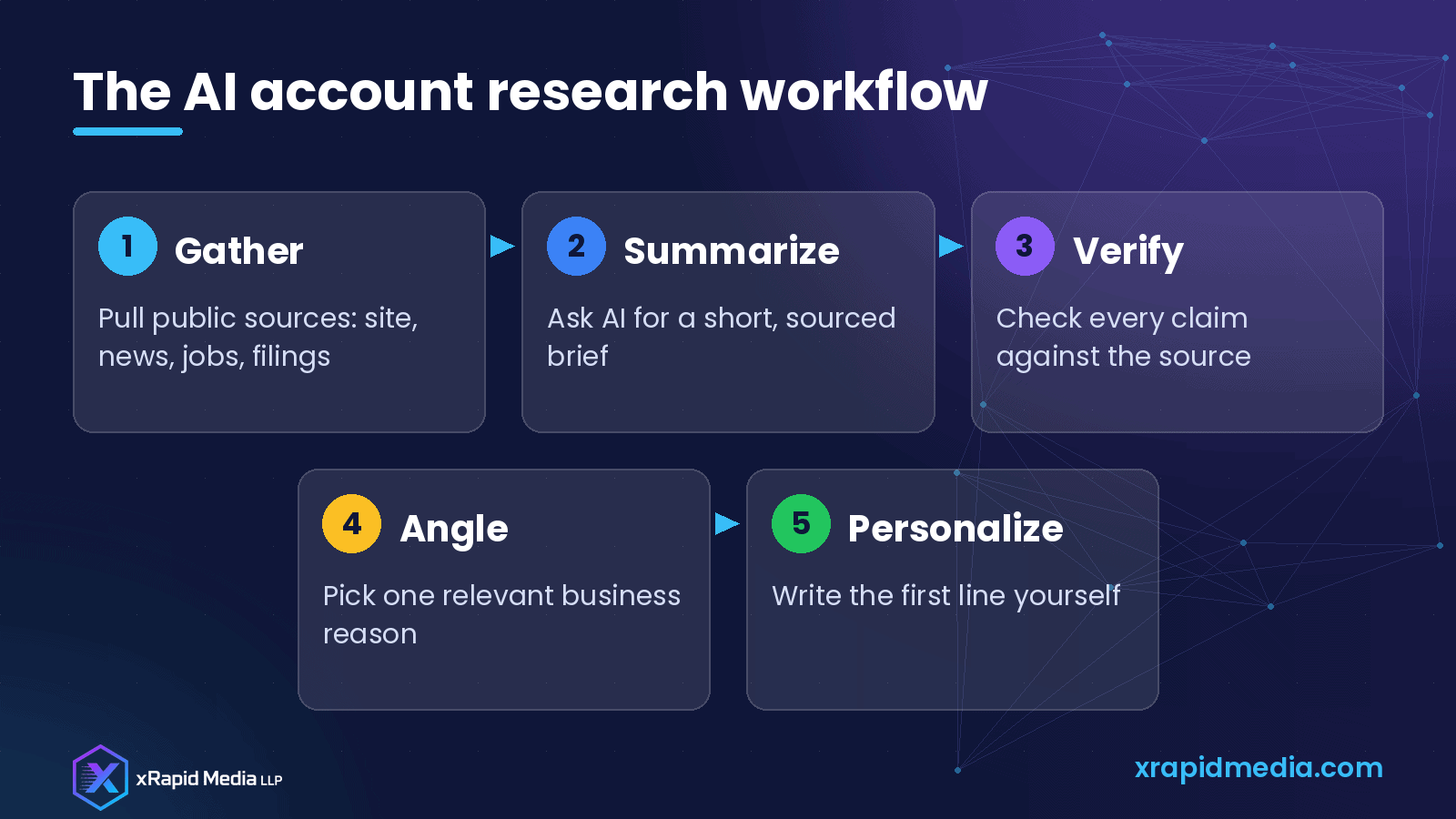
Step 2: Ask for a short, structured brief
Long summaries are hard to use. Ask for a brief in a fixed format so every account looks the same. A prompt like this works well:
“Using only the sources below, write a short account brief with: what the company sells and to whom, any recent changes (funding, launches, expansion, leadership hires), open roles that suggest priorities, and two possible reasons a company like ours could be relevant. For each point, note which source it came from. If something isn’t in the sources, say so.”
That last instruction matters. Asking the tool to cite sources and admit gaps makes it much easier to spot anything it has made up.
Step 3: Verify before you trust
This is the step people skip, and it’s the one that protects your reputation. AI tools can confidently state things that are wrong, outdated or about a different company with a similar name.
Before you use any detail in outreach, check it against the original source. Pay special attention to:
- Names and job titles, which change often.
- Numbers like headcount, revenue or funding amounts.
- Dates, especially for news that may be a year or two old.
- Product names and customer names.
If you can’t confirm a detail quickly, leave it out. A slightly less personal message is far better than a confident mistake.
Step 4: Pick one business reason to reach out
A good brief usually suggests several possible angles. Resist the urge to use them all. Pick the single most relevant reason and build your message around it.
For example, if a SaaS company has just posted several roles for customer success managers, a reasonable angle is that they’re scaling support and onboarding. If an IT services firm has announced a new office in Texas, the angle might be building a pipeline in a new region.
One clear reason is easier to read and easier to reply to than a paragraph listing everything you found.
Step 5: Write the first line yourself
AI can draft emails, but the opening line is where a human touch matters most. Use the brief to write one or two sentences that show you’ve done your homework, in your own words.
Compare these two openings:
- “I hope this email finds you well. I noticed your company is a leader in innovative cloud solutions.”
- “I saw you’re hiring three solutions engineers for the Chicago office. Usually that means the sales team is getting more demo requests than it can handle.”
The second one is specific, accurate and gives the reader a reason to keep going.
Building this into your weekly routine
A simple way to make AI research a habit:
- On Monday, choose the accounts you’ll contact that week.
- Gather sources for each and generate briefs in one batch.
- Spend a few minutes verifying each brief and picking the angle.
- Save the brief to the account record in your CRM so anyone on the team can use it later.
Saving briefs in the CRM also means you aren’t starting from scratch when the account comes back around in three months.
A few guardrails
Be thoughtful about what you paste into AI tools. Public information is generally fine, but avoid sharing confidential customer data or internal documents with tools your company hasn’t approved. If your business has an AI usage policy, follow it.
And keep the tone respectful. Researching a company’s public news is normal. Mentioning a prospect’s personal social media or private details is not.
Wrapping up
AI account research isn’t about replacing your judgment. It’s about spending less time collecting information and more time thinking about why your offer matters to a specific buyer. Gather real sources, ask for a structured brief, verify every detail and write the opening yourself. Your outreach will be faster and more relevant at the same time.
About xRapid Media
xRapid Media LLP is a High Tech B2B Marketing company for technology businesses: software and SaaS companies, IT services and managed service providers, and hardware and IT product vendors. Our team combines positioning and content, account-based marketing, paid ads funnels, verified B2B data, intent signals, email and LinkedIn outreach and appointment setting to help you reach the right buyers and turn their attention into qualified leads and meetings.
Want help putting ideas like these into practice? Email [email protected] or book a time with our team.