
For many organizations, a security purchase does not start with a breach or a new threat. It starts with an audit finding, a customer questionnaire or a framework the business has committed to meet. A compliance manager needs evidence for a control. An IT director needs to close a gap before the next assessment. A sales leader at a software company needs to answer an enterprise prospect’s security requirements.
That makes compliance one of the most reliable demand drivers in cybersecurity. It also makes it one of the easiest places for vendors to overclaim. Phrases like “become compliant instantly” or “guaranteed audit success” may get clicks, but they create risk for the buyer and the vendor, and experienced compliance professionals see through them quickly.
Our team at xRapid Media LLP helps cybersecurity vendors and managed security providers build demand generation programs that earn trust. Here is how we approach compliance-led marketing without overpromising.
Understand how compliance buyers think
Compliance-driven buyers are usually careful, evidence-focused and accountable to someone else, such as an auditor, a board or a major customer. They are often asking:
- Which specific requirement or control does this help us meet?
- What evidence will it produce, and in what format?
- What remains our responsibility after we buy it?
- Has the vendor itself been assessed, and can we see the report?
Marketing that answers these questions directly feels useful. Marketing that skips to big promises feels like a liability.
Choose your words carefully
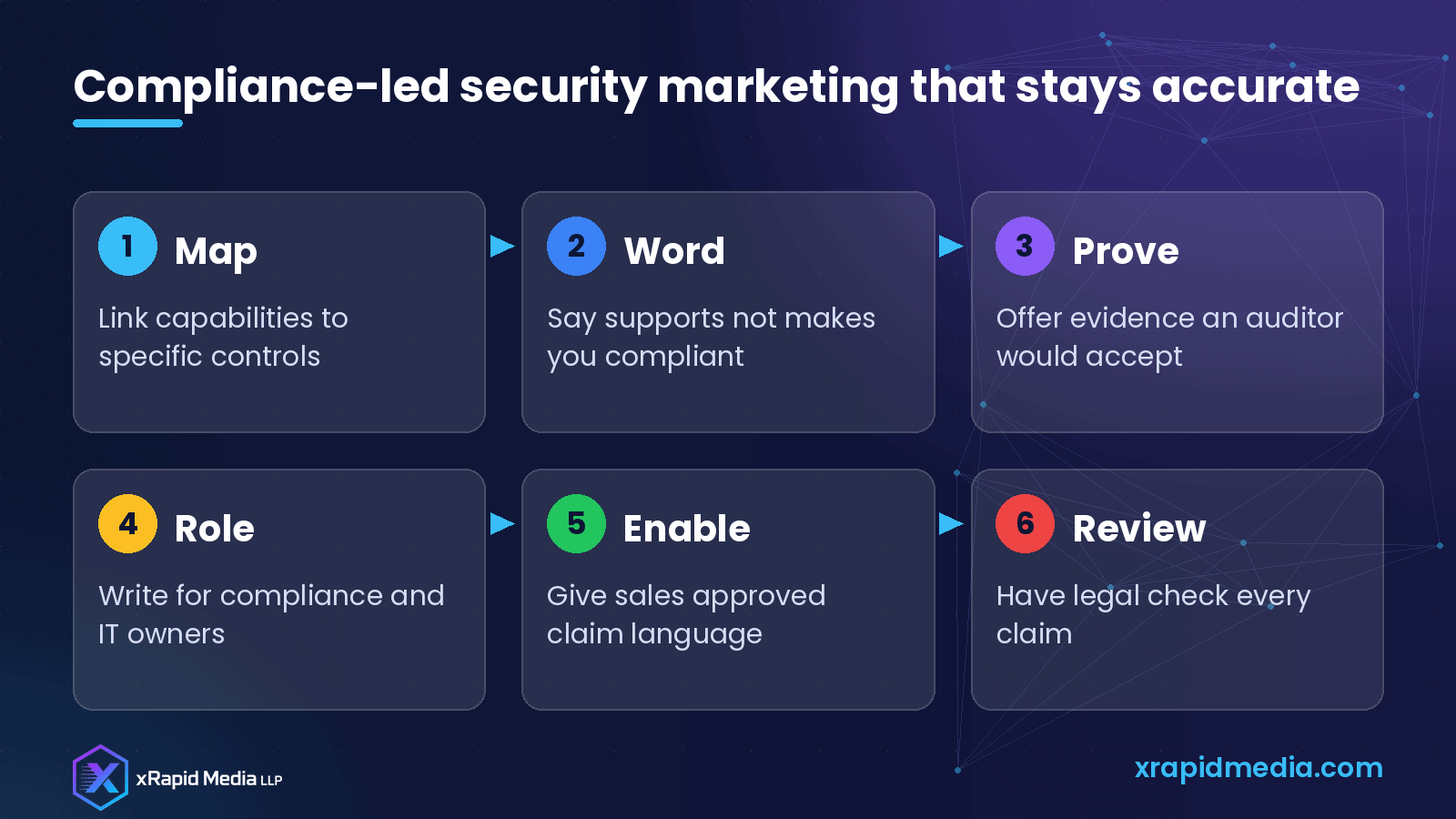
Security tools rarely make an organization compliant on their own. Compliance depends on policies, processes, people and evidence across the business. Your copy should reflect that.
Safer phrasing includes “helps you meet,” “supports evidence for,” “maps to” and “simplifies reporting for.” Phrasing to avoid includes “makes you compliant,” “certified for” a framework that does not certify products, or anything that implies an outcome only an auditor can decide.
Be equally careful about your own attestations. If your company has completed an independent audit, say which one, the scope and how a customer can request the report. If an assessment is in progress, say that plainly. Never imply a certification you do not hold.
Map capabilities to controls
The most helpful compliance content connects what your product does to the requirements buyers are working through. A clear control mapping, organized by framework, lets a compliance manager see where your tool fits and where it does not.
Keep mappings honest. Mark controls your product fully supports, those it partially supports and those that remain the customer’s responsibility. That level of candor often shortens sales cycles, because it answers the questions a security reviewer would otherwise send back.
Offer evidence an auditor would recognize
Compliance buyers want to see what the output looks like. Useful assets include:
- Sample reports and evidence exports, with dummy data.
- A short walkthrough of how the product records and retains logs relevant to common controls.
- A shared responsibility summary that separates vendor and customer duties.
- Your own security documentation pack, available on request.
A practical example: a vendor selling an access review tool could publish a sample quarterly access review report and a page explaining which common control requirements it helps evidence. That gives the buyer something concrete to show their auditor during evaluation.
Write for the compliance owner and the IT owner
Compliance purchases usually involve at least two roles. The compliance or risk owner cares about evidence, reporting and audit readiness. The IT or security owner cares about deployment, integrations and the operational work the tool creates.
Create content for both. A compliance-focused guide might explain how to prepare evidence for a framework review. An IT-focused guide might cover deployment steps and integration with existing identity and logging tools. Use account-based campaigns to put both in front of the right people at target accounts.
Use compliance timing without fear tactics
Compliance has natural timing: annual audits, customer contract renewals, new framework versions and regulatory deadlines. These create genuine moments when buyers research solutions.
Use them through helpful content, not alarm. An article on preparing for an audit cycle, a checklist for a framework update or a webinar with a practitioner who has been through the process can all generate qualified interest. Intent data can help you spot target accounts researching specific frameworks so outreach arrives with relevant material instead of a generic pitch.
Give sales approved language
Overclaiming often happens in sales conversations and outreach emails, not just on the website. Give reps a short guide with approved phrases, claims to avoid and links to evidence assets. Include sample answers for common questions like “Will this make us compliant?” A good answer explains what the product supports, what evidence it provides and what the customer still owns.
Review every claim
Have legal or a compliance specialist review new compliance-related content before it goes live, and revisit existing pages when frameworks change or your own attestations are renewed. Outdated claims on old pages can create as much risk as new ones.
Conclusion
Compliance-driven buyers reward vendors who are precise. Map capabilities to controls honestly, use careful language, show evidence an auditor would recognize, speak to both compliance and IT owners and give sales approved wording.
If you want help building cybersecurity marketing that earns trust and generates qualified pipeline, book a free B2B marketing consultation with xRapid Media LLP.
About xRapid Media
xRapid Media LLP is a High Tech B2B Marketing company for technology businesses: software and SaaS companies, IT services and managed service providers, and hardware and IT product vendors. Our team combines positioning and content, account-based marketing, paid ads funnels, verified B2B data, intent signals, email and LinkedIn outreach and appointment setting to help you reach the right buyers and turn their attention into qualified leads and meetings.
Want help putting ideas like these into practice? Email [email protected] or book a time with our team.