
Ask a B2B sales rep for the competitive battle card and you often get a shrug, a outdated PDF or a slide that reads like a press release. The card failed as a product. It was too long, too biased, too hard to find or too stale to trust on a live call.
Our team helps software and SaaS companies build enablement assets that reps use under pressure. Battle cards earn a place in the workflow when they are short, honest and maintained like a living tool.
What a battle card is for
A battle card is a call-time aid. It should help a rep:
- Recognize when a rival is in the deal
- Ask better discovery questions
- Position without badmouthing
- Handle the five objections that always appear
- Know when to pull in a specialist
It is not a fifty-page teardown, a legal brief or a brand manifesto.
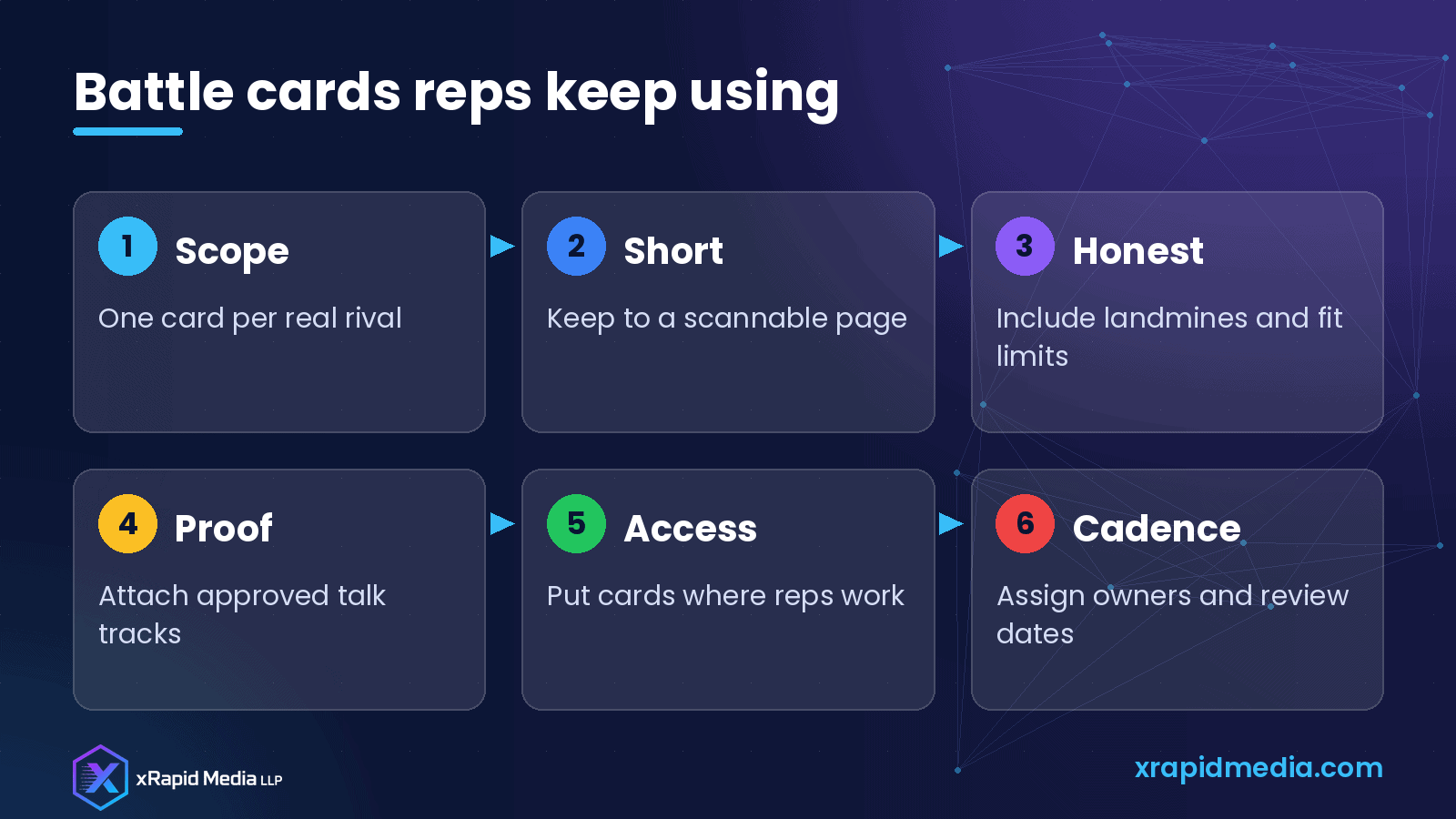
Build cards only for rivals that show up
Use CRM data and win/loss notes. If a company never appears in late stage, skip the card for now. Depth on three rivals beats thin coverage of fifteen.
Include a “status quo / do nothing / build in-house” card when that is the real alternative.
The one-page structure that works
Keep each card scannable:
- When we usually win and when we usually lose
- Their likely pitch in one sentence
- Landmines to avoid (claims we cannot support)
- Discovery questions that surface fit
- Three proof points with links to approved assets
- Objection / response pairs in plain language
- “If we hear X, escalate to Y”
- Last reviewed date and owner
Use bullet fragments, not paragraphs. Reps glance between discovery answers; they do not read essays on Zoom.
Honesty is a feature
Include weaknesses. If a rival has a stronger native integration for a common stack, say so and teach the rep how to position around workflow, support model or total cost instead of denying reality. Reps lose trust in enablement the first time a card contradicts what buyers say.
Never invent competitor flaws. Stick to public facts, documented customer feedback you are allowed to use and patterns from verified win/loss interviews.
Put cards where work already happens
Host battle cards inside the CRM, the enablement workspace or the dialer notes template, with a single source of truth. Duplicate PDFs in email kill version control. A chat pinned link to the live card beats a deck buried in a folder named “Final_v7.”
Train with call recordings: show a good use of the card and a call where a stale claim hurt credibility.
Create a maintenance cadence
Assign a product marketing or enablement owner per card. Review on a fixed rhythm and after major competitor launches. Collect field notes in one channel: “buyer said they now offer Z.” Triage weekly. Show a visible last-reviewed date so reps know what is safe.
When messaging changes on your side, update cards the same week you update the website and decks.
Tie cards to other assets
Each proof point should link to a case study, comparison page, security FAQ or demo clip. The card points; the asset persuades. If the link is broken, fix it faster than you write new slogans.
Marketing should also feed cards from competitive intelligence workflows so research does not die in a private doc.
Measure usage, not applause
Look at opens or CRM attachment rates, rep surveys, win rate in head-to-head deals and qualitative feedback from managers listening to calls. If usage is low, shorten the card before you add more sections.
Ask new hires which card helped in their first thirty days. Onboarding is a truth serum for enablement quality.
Common mistakes
- Writing cards as internal venting about competitors
- Including unverified pricing that changes monthly
- Forbidding any mention of tradeoffs
- Updating brand guidelines monthly while cards sit untouched for a year
- Keeping cards only in a slide theme nobody can edit quickly
Ship a useful v1 in two weeks
Week one: pick top two rivals, interview three reps and one SE, draft one-pagers. Week two: place them in the CRM, run a thirty-minute training, gather edits, publish ownership and review dates. Expand only after those two are used in live deals.
Battle cards are a productivity tool for revenue teams. Treat them like product: narrow scope, fast iteration, clear owners and respect for the people who use them when a deal is on the line.
If you want help building competitive enablement, comparison pages and the research behind them for a B2B software team, xRapid Media LLP can partner with marketing and sales leadership. Book a free B2B marketing consultation and we will review what reps need before their next head-to-head call.
About xRapid Media
xRapid Media LLP is a High Tech B2B Marketing company for technology businesses: software and SaaS companies, IT services and managed service providers, and hardware and IT product vendors. Our team combines positioning and content, account-based marketing, paid ads funnels, verified B2B data, intent signals, email and LinkedIn outreach and appointment setting to help you reach the right buyers and turn their attention into qualified leads and meetings.
Want help putting ideas like these into practice? Email [email protected] or book a time with our team.