
Engineers and DevOps teams like to try things themselves. Before they recommend a monitoring tool, CI/CD platform or cloud security product to their manager, they want to see it working with their own code, their own infrastructure and their own problems.
That’s why so many cloud and DevOps companies offer free trials, free tiers or sandbox environments. But many of those trials end the same way: someone signs up, pokes around for ten minutes and never comes back.
Here’s how our team helps cloud and DevOps companies design trials that turn interest into real pipeline.
Decide what the trial is for
Before changing anything, be clear about the goal. A trial can do different jobs:
- Let individual engineers evaluate the product on their own
- Support a sales-led evaluation for a larger team
- Act as a free tier that grows into paid usage over time
Each needs a slightly different design. Many companies try to do all three at once and end up doing none well.
Make sign-up quick
Technical users are impatient with friction. Ask only for what you need to create an account. Offer sign-in with common identity providers if it fits your audience. If you need more information for qualification, collect it later or enrich it from your B2B data.
Be honest about limits up front. If the trial lasts 14 days or has usage caps, say so clearly. Surprises later destroy trust.
Get users to a first win fast
The most important moment in any trial is the first time the product does something useful. For a monitoring tool, that might be seeing real metrics from the user’s own service. For a CI/CD tool, a first successful pipeline run.
Work backward from that moment and remove every step you can. Useful tactics include:
- Sample projects and demo data that work instantly
- Copy-and-paste setup commands
- Templates for common stacks and cloud providers
- Clear error messages that explain how to fix problems
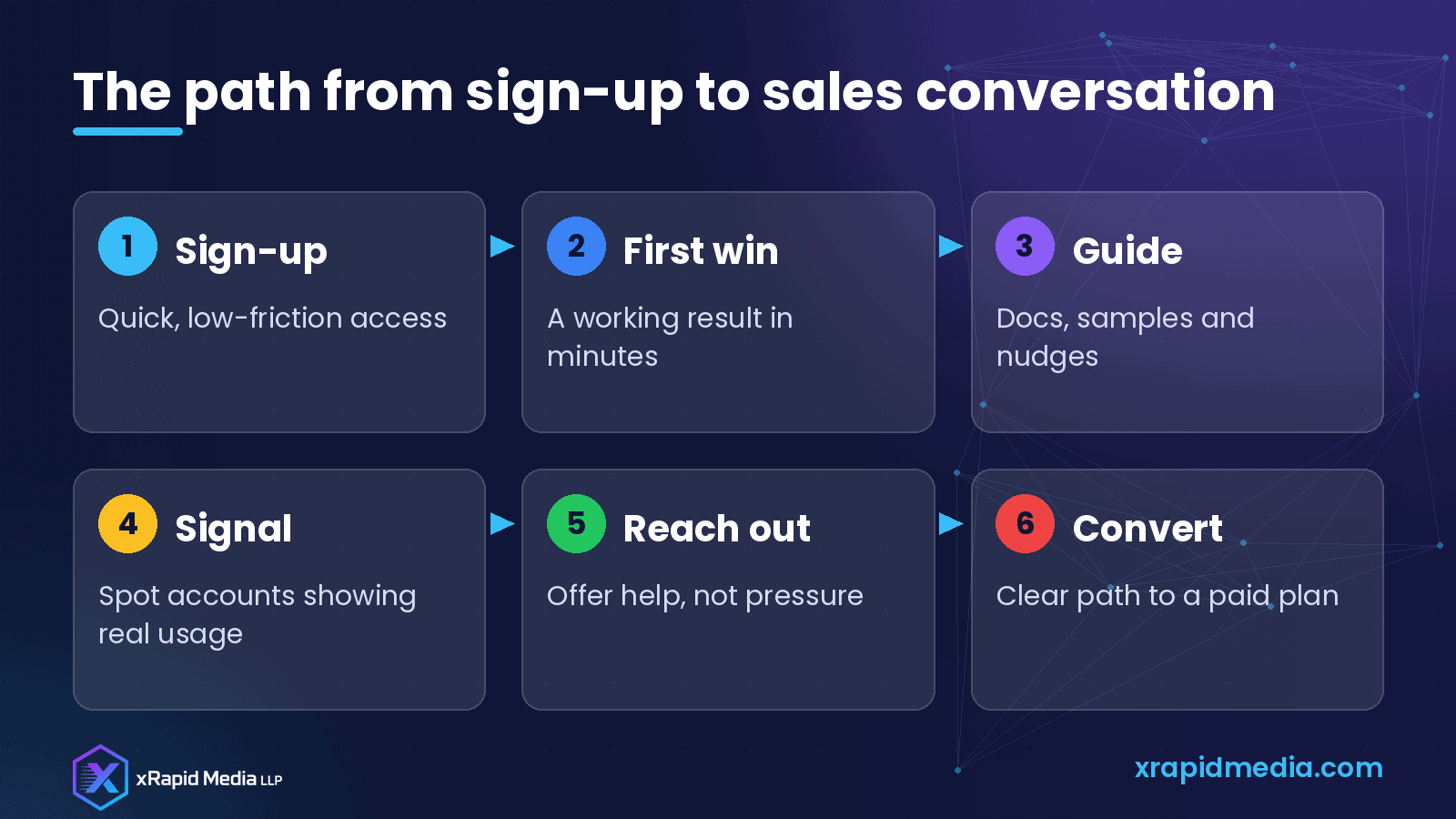
Guide without nagging
Most trial users won’t read long documentation up front. Give them short, contextual help: tooltips, checklists inside the product and well-timed emails that point to the next useful step.
Base emails on what users actually did. Someone who connected a data source needs different guidance from someone who hasn’t logged in since day one. Generic “Day 3 tips” emails sent to everyone are easy to ignore.
Watch for buying signals
Usage data tells you which trials have real potential. Signals might include:
- Several people from the same company signing up
- Connecting production systems or real data
- Hitting usage limits
- Visiting pricing, security or enterprise plan pages
- Inviting teammates or setting up integrations
Share these signals with sales and customer success so they can focus on the accounts showing serious interest. This is the idea behind product-qualified leads.
Reach out the right way
Engineers generally don’t want a sales call ten minutes after signing up. But they often welcome help from someone technical when they’re stuck or ready to scale.
Make outreach useful: offer a technical walkthrough, help with a specific integration or a conversation about security and compliance requirements. Have a solutions engineer or technical account manager involved where possible. Keep the tone helpful, not pushy.
Support the bigger buying decision
An engineer may love your product, but someone else often approves the budget. Help your champion make the case internally with:
- A simple summary of what the tool does and why it matters
- Security documentation and compliance information
- Pricing that’s easy to understand and estimate
- Customer stories from similar companies, where you have them
Make it easy to move from a trial to a team or enterprise plan without losing work.
Measure trial health
Track more than sign-ups. Useful metrics include:
- Share of trials that reach the first win
- Time to first win
- Share of trials with multiple users from one company
- Trial-to-paid conversion
- Sales opportunities that came from trials
Look for where people drop off and fix those steps first.
Common trial mistakes
- Asking for too much information at sign-up
- Dropping users into an empty dashboard
- Sending the same email sequence to everyone
- Calling every trial user immediately
- Ending trials abruptly without a clear next step
Make the trial do the selling
A good trial is one of the strongest sales tools a cloud or DevOps company can have, because it lets the product prove itself. The key is to design it on purpose and connect it to your marketing and sales process.
At xRapid Media LLP, we help cloud, DevOps and SaaS companies with positioning, content, intent data and outreach that complements product-led growth. If you’d like to turn more trials into conversations, book a free B2B marketing consultation with our team.
About xRapid Media
xRapid Media LLP is a High Tech B2B Marketing company for technology businesses: software and SaaS companies, IT services and managed service providers, and hardware and IT product vendors. Our team combines positioning and content, account-based marketing, paid ads funnels, verified B2B data, intent signals, email and LinkedIn outreach and appointment setting to help you reach the right buyers and turn their attention into qualified leads and meetings.
Want help putting ideas like these into practice? Email [email protected] or book a time with our team.