

Ask five people at an early-stage SaaS company what the product does, and you’ll often hear five different answers. One person talks about the AI, another about integrations, the founder describes a vision for the whole industry, and sales says something else again. Then the website tries to say all of it at once.
Buyers don’t have the patience to sort that out. If someone visits your homepage and can’t explain to a colleague what you do and who it’s for, you’ve probably lost them. That’s what positioning fixes. It’s the work of deciding, clearly and deliberately, how you want the right buyers to understand your product. Here’s the simple exercise our team runs with B2B founders.
What positioning is, and isn’t
Positioning is not a tagline or a logo. It’s the underlying decision about:
- Who your product is for.
- What problem it solves for them.
- What they would use if you didn’t exist.
- Why your approach is better for them specifically.
Your tagline, homepage headline, sales pitch and ad copy all come from that decision. When positioning is clear, all of these get easier to write and more consistent with each other.
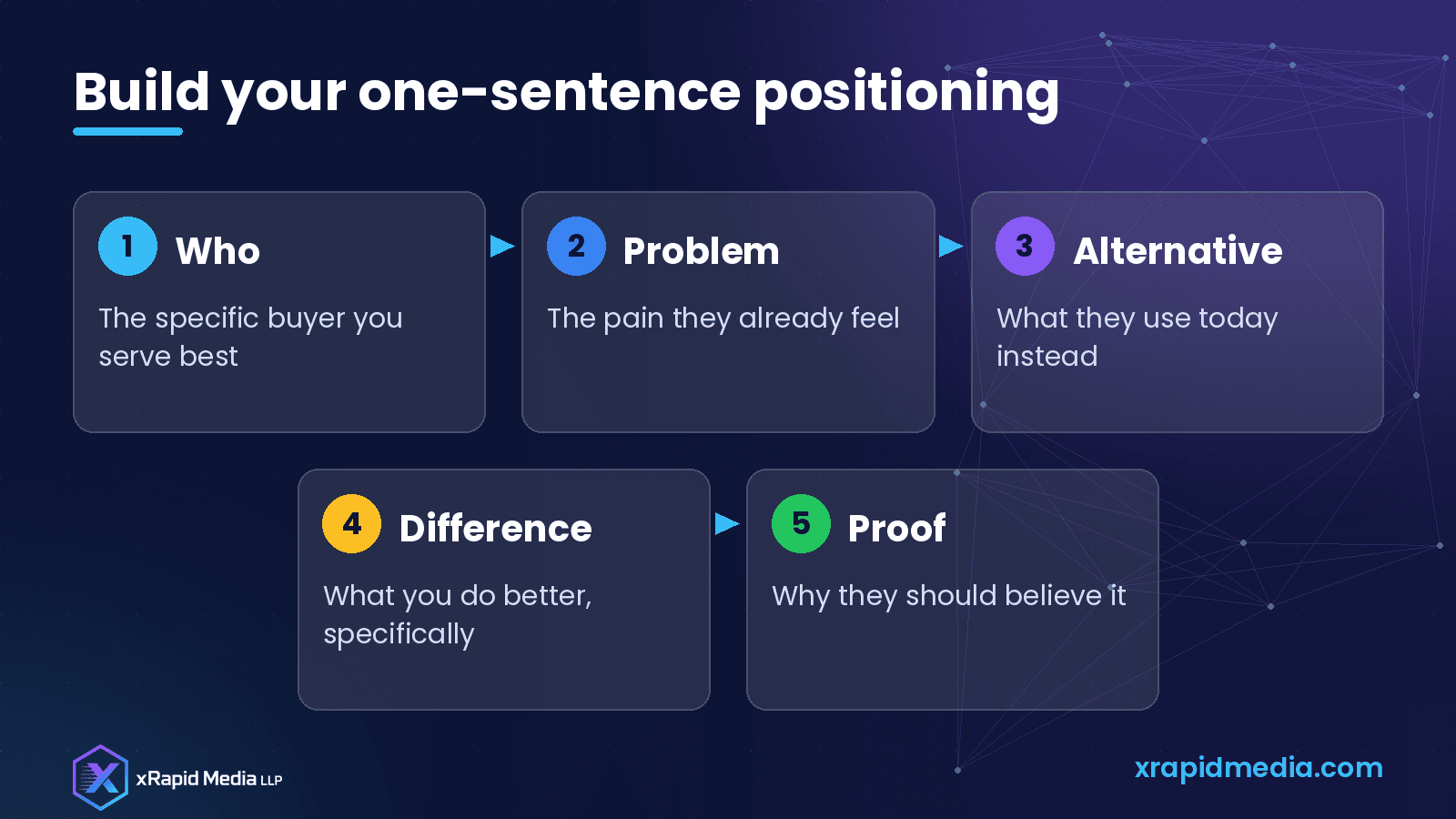
Step 1: Pick the buyer you serve best
Early-stage companies are often tempted to say their product is for “any business.” It rarely is, and even when it technically could be, that message doesn’t resonate with anyone.
Look at your best current customers, the ones who got value quickly, stayed and would recommend you. What do they have in common? Industry, company size, team, role, tech stack or a particular situation, such as a company that has just outgrown spreadsheets.
Write it down as specifically as you can. “Operations managers at US logistics companies with 50 to 500 employees” is far more useful than “businesses that want efficiency.”
Step 2: Name the problem in their words
Describe the problem the way your buyer would describe it to a colleague, not the way your engineers would. Listen to sales calls, read support tickets and look at the words customers use in reviews.
For example, a buyer probably doesn’t say “we lack a unified data orchestration layer.” They say “every Monday someone spends half a day copying numbers between three systems, and the report is still wrong.”
Using the buyer’s language makes them feel understood immediately.
Step 3: Be honest about the alternative
Your real competitor is often not another startup. It might be a spreadsheet, a manual process, a big established platform or simply doing nothing. Understanding what buyers use today tells you what you need to beat.
Ask customers what they did before they found you and why it stopped working. Their answers usually point straight to your strongest message.
Step 4: State your difference specifically
“Easy to use,” “powerful” and “AI-powered” are claims almost every SaaS company makes, so they don’t distinguish anyone. Your difference should be something specific and meaningful to your chosen buyer.
Good examples look like:
- Works inside the tools they already use, so there’s no new system to learn.
- Set up in an afternoon without IT help.
- Built for a specific compliance requirement in their industry.
- Priced per location rather than per user, which suits their business model.
If you can’t think of a clear difference for a particular buyer, that may be a sign they’re not the right buyer to focus on.
Step 5: Back it up with proof
Buyers need a reason to believe you. Proof can include customer stories, short testimonials, before-and-after examples, a free trial, a live demo or a clear explanation of how the product works. Use real examples and get permission before naming customers.
Put it into one sentence
Now combine your answers into a single sentence. A simple template:
“We help [specific buyer] [solve specific problem] by [your key difference], unlike [their current alternative].”
For example: “We help operations managers at mid-sized logistics companies get accurate weekly reports without manual copying, by connecting directly to the systems they already use, unlike spreadsheets that break every time someone changes a column.”
It won’t be your homepage headline word for word, but it gives everyone on the team the same starting point.
Test it with real people
Share your positioning sentence and a draft homepage headline with a few target buyers who don’t know your product. Ask them to explain back what you do and who it’s for. If their answer matches your intent, you’re on track. If not, adjust and test again.
You can also test positioning through outreach and ads. Try two different problem statements in emails or LinkedIn ads to the same audience and see which gets more thoughtful replies.
Use it everywhere
Once you’re confident, roll your positioning out across the homepage, sales deck, LinkedIn page, outreach templates, ads and investor materials. Consistency is what helps the market remember you.
Revisit positioning as you grow. New products, new markets or new competitors can all shift what the clearest story is.
Wrapping up
Strong positioning helps the right buyers recognize themselves in your message within seconds. Choose the buyer you serve best, name their problem in their words, understand their current alternative, state your difference specifically and back it with proof. Turn that into one clear sentence, test it and use it everywhere. Your marketing will get simpler, and your sales conversations will start from a much better place.
About xRapid Media
xRapid Media LLP is a High Tech B2B Marketing company for technology businesses: software and SaaS companies, IT services and managed service providers, and hardware and IT product vendors. Our team combines positioning and content, account-based marketing, paid ads funnels, verified B2B data, intent signals, email and LinkedIn outreach and appointment setting to help you reach the right buyers and turn their attention into qualified leads and meetings.
Want help putting ideas like these into practice? Email [email protected] or book a time with our team.