
Most beta programs for mobile apps are treated as a testing phase: invite some users, collect bug reports, fix what breaks and move on. For consumer apps that can be enough. For B2B mobile apps, a beta is also one of the best go-to-market tools you have.
The teams that join a beta are often the same kind of organizations you want as customers. If the program is designed well, they become your first references, your clearest source of positioning language and, in many cases, your first paying accounts.
Our team at xRapid Media LLP, a High Tech B2B Marketing company, helps software and app companies plan launches that create pipeline. Here is how we recommend structuring a B2B mobile app beta.
Decide what the beta is for
Write down two or three goals before you recruit anyone. Common ones include:
- Validating that the core workflow works in real field, warehouse or office conditions.
- Learning how IT admins deploy and manage the app across devices.
- Testing integrations with the tools customers already use.
- Gathering evidence and stories for launch messaging.
Each goal shapes who you invite and what you ask them. A beta focused on device management needs admin participation. A beta focused on field usability needs frontline workers.
Recruit teams, not just individuals
B2B mobile apps succeed or fail at the team level. One enthusiastic user on a personal phone tells you very little about how a 40-person service team will use the app on managed devices.
Aim for beta accounts that match your ideal customer profile and include:
- A sponsor who owns the business problem, such as an operations or service manager.
- A handful of everyday users who will rely on the app in their work.
- Someone from IT who can speak to security, provisioning and support.
Good recruiting sources include existing customers of your other products, waitlist signups, partners who serve your target market and targeted outreach to accounts that have shown interest. Be clear about what participation involves: time commitment, feedback sessions and what they get in return.
Make onboarding easy and supported
Beta users are forgiving about missing features but not about wasted time. Reduce friction with:
- A short setup guide written for both admins and end users.
- Distribution through the channels their IT team expects, such as test tracks or enterprise distribution, where appropriate.
- A named contact on your team and a simple way to report issues from inside the app.
- A kickoff call that explains goals, timeline and how feedback will be used.
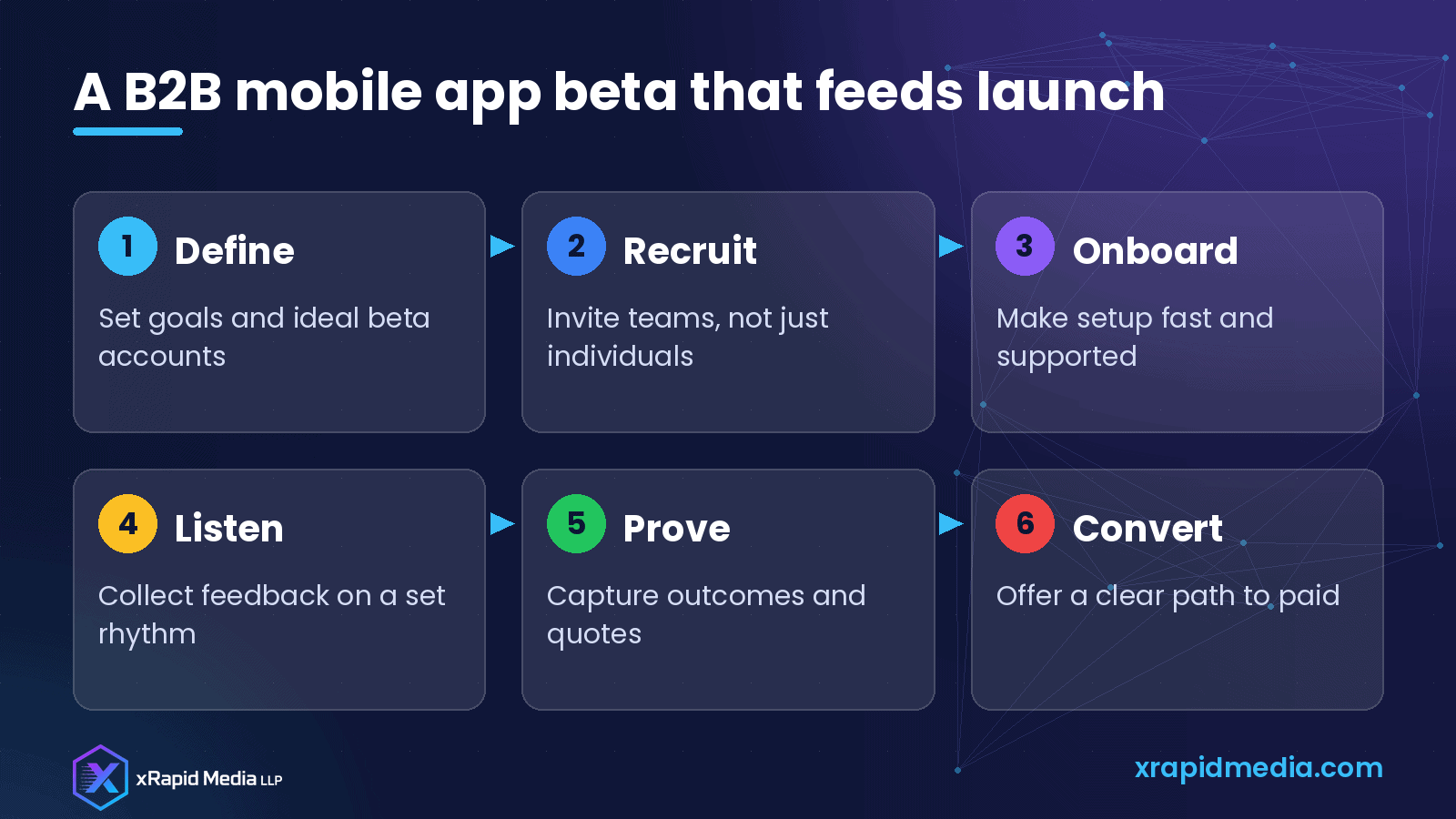
Collect feedback on a rhythm
Ad hoc feedback produces noise. A steady rhythm produces insight. A simple structure might include:
- A short in-app survey after the first week.
- A 30-minute call with the sponsor every two weeks.
- Usage data reviewed weekly, focusing on whether key workflows are completed.
- A wrap-up interview at the end of the beta.
Ask questions that reveal value, not just usability: “What did your team stop doing because of the app?” and “What would happen if you had to go back to the old way tomorrow?” The answers become your launch messaging.
Capture proof as you go
Do not wait until the beta ends to think about case studies. Throughout the program, note:
- Before-and-after descriptions of the workflow in the customer’s own words.
- Outcomes the customer is willing to describe publicly, even if they are qualitative.
- Screenshots and short videos of the app in use, with permission and without sensitive data.
- Quotes from sponsors and IT contacts, approved in writing.
Never round up or invent results. If a beta account says the app “saved their technicians a lot of back-and-forth,” use that language rather than inventing a percentage.
Offer a clear path to paid
The end of a beta is a natural buying moment, but only if you prepare for it. Before the program finishes:
- Share launch pricing and packaging with sponsors early, so there are no surprises.
- Offer a fair incentive for beta accounts that convert, such as a founding-customer rate for the first term.
- Make the transition seamless, keeping their data, settings and users intact.
- Ask converting accounts whether they will act as a reference or join a launch story.
Accounts that decide not to buy are still valuable. Ask why, and treat their answers like win-loss interviews.
Use the beta in your launch campaign
Your beta gives you material most launch campaigns lack: real teams using the app in real conditions. Turn it into launch-day assets, such as a customer story, a short video, a “built with our beta customers” message on the website and sales talking points grounded in actual feedback.
Conclusion
A B2B mobile app beta should be planned like a go-to-market program, not just a test cycle. Recruit full teams that match your ideal customer, support them well, listen on a rhythm, capture proof carefully and give them an easy path to becoming paying customers.
If you are preparing to launch a B2B mobile app and want help turning your beta into early pipeline, book a free B2B marketing consultation with xRapid Media LLP.
About xRapid Media
xRapid Media LLP is a High Tech B2B Marketing company for technology businesses: software and SaaS companies, IT services and managed service providers, and hardware and IT product vendors. Our team combines positioning and content, account-based marketing, paid ads funnels, verified B2B data, intent signals, email and LinkedIn outreach and appointment setting to help you reach the right buyers and turn their attention into qualified leads and meetings.
Want help putting ideas like these into practice? Email [email protected] or book a time with our team.