
Most B2B tech companies put serious effort into a webinar. A product manager or engineer prepares for days, the team promotes it for weeks, and the session itself often contains the clearest explanation of the product’s value that exists anywhere. Then the recording goes on a resource page and the ideas quietly disappear.
AI tools make it tempting to fix that by pasting a transcript into a chatbot and asking for “ten LinkedIn posts and a blog.” The output arrives in seconds. It also tends to sound like every other vendor, because the model sands off the specific examples, caveats and opinions that made the session worth attending.
Our team at xRapid Media LLP, a High Tech B2B Marketing company, helps software, SaaS, IT services and hardware companies get more pipeline from the content they already create. Here is the workflow we use when AI is part of webinar repurposing.
Start with a transcript you trust
Everything downstream depends on the raw material. Before you generate anything:
- Get a full transcript with speaker labels, not just an auto-summary.
- Clean obvious transcription errors in product names, acronyms and customer names.
- Note the timestamps of demos, audience questions and moments where the speaker told a story.
- Remove anything that should not leave the room, such as roadmap hints or customer details shared off the cuff.
Treat this cleaned transcript as the source of truth. Every derived piece should trace back to something that was actually said.
Ask AI to mine, not to write
The most useful first prompt is not “write a blog post.” It is closer to: “List every distinct claim, example, framework, objection and audience question in this transcript, with the timestamp and exact quote for each.”
That gives you an inventory instead of a draft. A one-hour technical webinar often produces a long list: a three-step framework the speaker sketched, a customer scenario, a comparison with an older approach, two pointed questions from attendees and a few strong one-liners.
Mining first has two benefits. You can see which ideas are genuinely strong before committing to formats, and the model is far less likely to invent things when it is asked to extract and cite rather than create.
Verify before you build
Have someone who attended, ideally the speaker or a product marketer, review the inventory against the recording. Check for:
- Quotes that were shortened in a way that changes their meaning.
- Claims that were qualified on the call (“in most deployments we have seen”) but appear absolute in the list.
- Numbers or results mentioned in passing that need a source before they appear in print.
- Ideas the model merged from two different parts of the conversation.
This step takes less time than it sounds, and it is where most of the quality comes from.
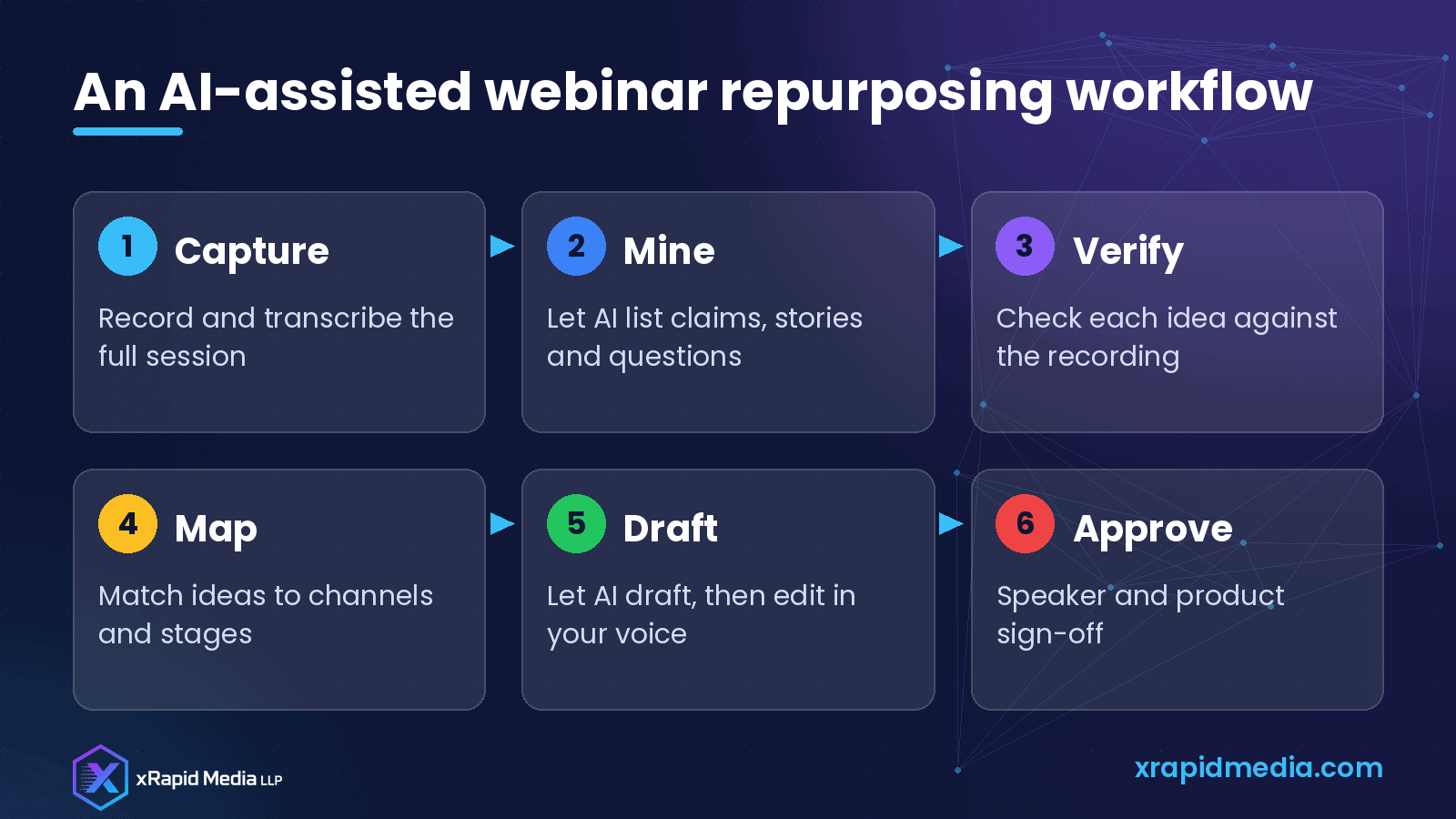
Map ideas to channels and buying stages
Not every idea belongs everywhere. Map the verified inventory to where it will do the most work:
- Blog article: the core framework, expanded with the speaker’s examples and a clear structure.
- Email nurture: two or three short emails, each built around one idea and linking to the recording.
- Social posts: strong one-liners and single tips, each standing alone without needing the full context.
- Sales follow-up: the objection-handling moments and audience questions, turned into short answers reps can send.
- FAQ or help content: recurring technical questions that deserve a permanent, searchable answer.
For example, if a cloud security vendor’s webinar included an attendee asking how the product handles multi-account setups, that one answer might become a FAQ entry, a sales snippet and a social post, each written for its own audience.
Let AI draft, then edit in your voice
Now AI drafting becomes much safer. Give the model one verified idea, the exact quotes behind it, the target channel and your style guide. Ask for a first draft that uses the speaker’s examples rather than generic ones.
Then edit like a person who cares about the brand:
- Put back the specific details the draft smoothed over.
- Cut phrases that could appear on any competitor’s site.
- Keep the speaker’s opinions where they are, even if they are a little sharp.
- Make sure each piece has one clear next step, such as watching the recording, reading the guide or booking a conversation.
A good rule of thumb is that if you could swap your company name for a competitor’s and the piece still works, it needs another pass.
Get the right approvals
Repurposed content carries the speaker’s name and your company’s credibility. Before publishing:
- Ask the speaker to approve anything that quotes or paraphrases them.
- Have product or engineering check technical explanations.
- Confirm any customer references are cleared for public use.
This also builds goodwill with internal experts. When they see their ideas presented accurately, they are far more willing to present again.
Schedule for weeks, not days
The value of repurposing comes from spreading ideas over time. A simple plan for a single webinar might look like this:
- Week one: recap blog post and email to registrants with the recording.
- Weeks two and three: social posts drawn from individual tips and questions.
- Week four: a nurture email built around the strongest framework.
- Ongoing: sales snippets and FAQ entries that stay in use for months.
Track which pieces drive replays, replies and meetings, and use that to decide which topics deserve the next webinar.
Measure what the campaign actually did
Look beyond views. Useful signals include recording views from target accounts, replies to follow-up emails, meetings where the rep used a webinar snippet and repeat visits to related product pages. If a particular idea consistently performs, it may deserve its own deeper asset.
Conclusion
AI can turn a single webinar into weeks of useful B2B content, but only if it works from a trusted transcript, mines ideas before drafting and leaves the final word to people who know the subject. Done this way, repurposing keeps your expert’s thinking front and center instead of replacing it with generic copy.
If you want help building a content engine that gets more pipeline from every webinar, demo and expert session, book a free B2B marketing consultation with xRapid Media LLP.
About xRapid Media
xRapid Media LLP is a High Tech B2B Marketing company for technology businesses: software and SaaS companies, IT services and managed service providers, and hardware and IT product vendors. Our team combines positioning and content, account-based marketing, paid ads funnels, verified B2B data, intent signals, email and LinkedIn outreach and appointment setting to help you reach the right buyers and turn their attention into qualified leads and meetings.
Want help putting ideas like these into practice? Email [email protected] or book a time with our team.