

For many business hardware purchases, a datasheet is not enough. An IT manager buying rugged tablets for field crews, conference room systems for a dozen offices or edge devices for a factory floor wants to see how the equipment behaves in their environment, with their software, network and users.
That is why evaluation units, often called demo or loaner units, are such a common part of selling IT hardware. They are also a common source of frustration. Devices go out, nobody checks in, the trial drifts on for months and the unit comes back scratched with no decision made. Sometimes it does not come back at all.
Our team at xRapid Media LLP, a High Tech B2B Marketing company, helps hardware vendors and resellers build programs that make evaluations a structured step in the sale. Here is how to do it.
Treat evaluation requests as high-intent leads
Someone asking to test hardware in their own environment is usually much further along than someone downloading a brochure. Make it easy to ask, and capture the information sales needs:
- Company, role and contact details.
- What problem the hardware should solve and where it will be used.
- How many units the full deployment might involve.
- The expected timeline for a decision.
- Who else is involved in the evaluation.
Keep the form short enough that it does not discourage genuine buyers. A sales rep can fill in gaps on a quick call.
Qualify before you ship
Evaluation units cost money in hardware, shipping, support and depreciation. Not every request should be approved. A short qualifying call helps confirm:
- There is a real project with a defined use case.
- The potential order justifies the cost of the evaluation.
- The person requesting the unit can influence the purchase decision.
- Someone on their side will actually test the device.
For requests that do not qualify, offer alternatives such as a recorded walkthrough, a virtual demo, a visit to a showroom or a reference call with an existing customer.
Agree success criteria up front
The most important step is often skipped: agreeing what a successful evaluation looks like before the unit ships. Write down together:
- The specific tests the buyer will run, such as battery life across a full shift, compatibility with their management software or video quality in their largest meeting room.
- Who will run the tests and who will review the results.
- The evaluation period, usually a few weeks, with a clear end date.
- What happens if the criteria are met, such as a pilot order or a formal proposal.
This turns an open-ended loan into a mutual plan. It also helps your champion explain the evaluation internally.
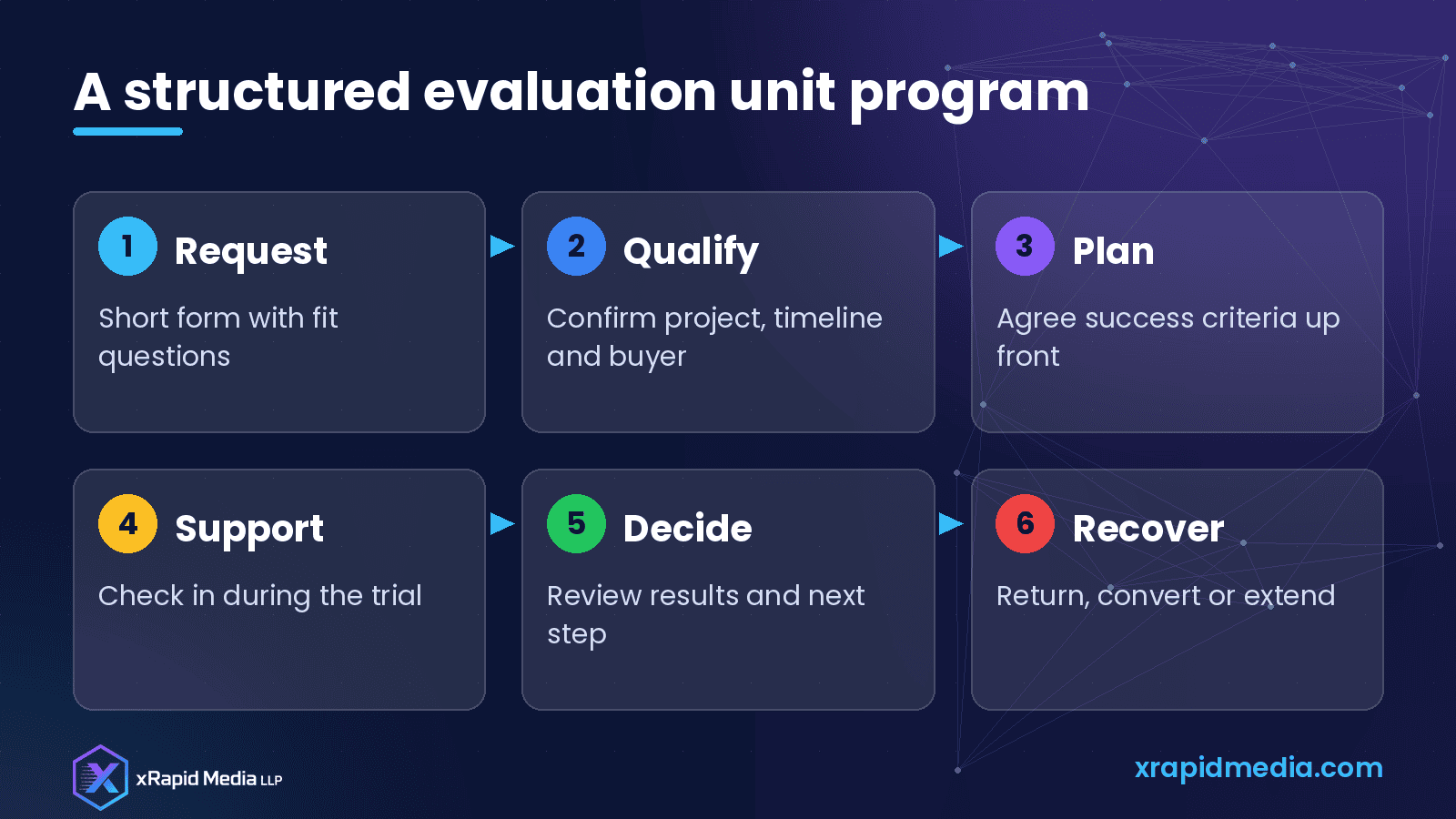
Support the buyer during the trial
A device sitting in a box does not sell itself. Plan touchpoints during the evaluation:
- A setup call or guide on the day the unit arrives.
- A check-in after the first week to answer questions and fix any issues.
- Access to a technical contact for integration or configuration problems.
- A reminder before the end date with a summary of what has been tested so far.
Pay attention to who is using the device. If the evaluator mentions colleagues trying it, ask whether they would like a short session for the wider team.
Hold a decision review
At the end of the trial, schedule a review meeting rather than simply asking for the unit back. Go through the success criteria one by one. Where the hardware met the criteria, move toward a proposal or pilot order. Where it fell short, find out why: configuration issues can often be fixed, while a genuine mismatch is worth knowing early.
Bring pricing, deployment and support options to this meeting, so the buyer has everything needed to take the next step.
Manage units like assets
Running a good program also means knowing where every device is. Track each unit’s serial number, location, customer, ship date, due date and condition. Set clear terms for returns, damage and extensions, and share them with the buyer in writing before shipping.
Refurbish and reset devices between evaluations so each buyer gets a clean, professional experience. A unit that arrives with someone else’s settings or a worn case sends the wrong signal.
Use evaluations in marketing
Evaluations create useful marketing material when customers agree to share it:
- Short quotes about how the hardware performed in a real environment.
- Case studies that follow a buyer from evaluation to rollout.
- Insights for your content team about the questions buyers ask most during trials.
You can also promote the program itself. “Test it in your environment before you buy” is a strong message for buyers worried about compatibility.
Measure the program
Track requests, approvals, units shipped, evaluations completed on time, conversion to orders and order value. Compare these numbers across product lines and segments to see where evaluations pay off and where alternatives such as virtual demos work just as well.
Conclusion
Evaluation units can be one of the most effective tools in B2B hardware sales, or one of the most expensive dead ends. Qualify requests, agree success criteria, support buyers during the trial, hold a decision review and manage every unit as an asset. That structure turns loaner devices into closed deals.
If you want help building lead generation and sales programs for your IT hardware, book a free B2B marketing consultation with xRapid Media LLP.
About xRapid Media
xRapid Media LLP is a High Tech B2B Marketing company for technology businesses: software and SaaS companies, IT services and managed service providers, and hardware and IT product vendors. Our team combines positioning and content, account-based marketing, paid ads funnels, verified B2B data, intent signals, email and LinkedIn outreach and appointment setting to help you reach the right buyers and turn their attention into qualified leads and meetings.
Want help putting ideas like these into practice? Email [email protected] or book a time with our team.