
Most cybersecurity marketing is written for security people. Datasheets explain detection methods, blog posts break down threat techniques and webinars dive into architecture. That makes sense, because security teams evaluate the technology.
But the final decision often sits elsewhere. A CISO or IT director may be convinced, then the request goes to a CFO who asks why the budget should grow, a CEO who wants to know what happens if the company says no, or a board that wants a clear view of risk. If your content cannot help your champion answer those questions, the deal slows down or stops.
Our team at xRapid Media LLP, a High Tech B2B Marketing company, works with cybersecurity vendors and MSSPs on content for every member of the buying committee. Here is how we approach the executive layer.
Understand what each executive cares about
Business leaders are not less interested in security. They just look at it through a different lens.
- CFOs think about cost, predictability and return. They want to know what the spend replaces, how it changes over time and what financial exposure it reduces.
- CEOs think about the business: customers, revenue, reputation and the ability to operate. They want to understand what could disrupt the company and how quickly it could recover.
- Board members think about oversight. They want assurance that risk is understood, managed and reported, and that leadership is making reasonable decisions.
- Legal and compliance leaders think about obligations: contracts, regulations and what the company has promised its customers.
Write for one of these readers at a time. A single “executive overview” that tries to speak to all of them usually ends up speaking to none.
Translate features into business outcomes
Executives do not need to know how your product detects lateral movement. They need to know what that capability means for the company. A useful exercise is to take each major feature and finish the sentence “which means the business can…”
For example:
- Faster detection and response, which means an incident is more likely to be contained before it disrupts operations.
- Centralized visibility, which means leadership can get a clearer answer when a customer or auditor asks about security controls.
- Managed monitoring around the clock, which means the company does not need to hire and retain a full in-house team for nights and weekends.
Avoid fear-heavy language. Business leaders hear warnings constantly, and exaggerated threats can make your brand look less credible. Calm, specific explanations tend to build more trust.
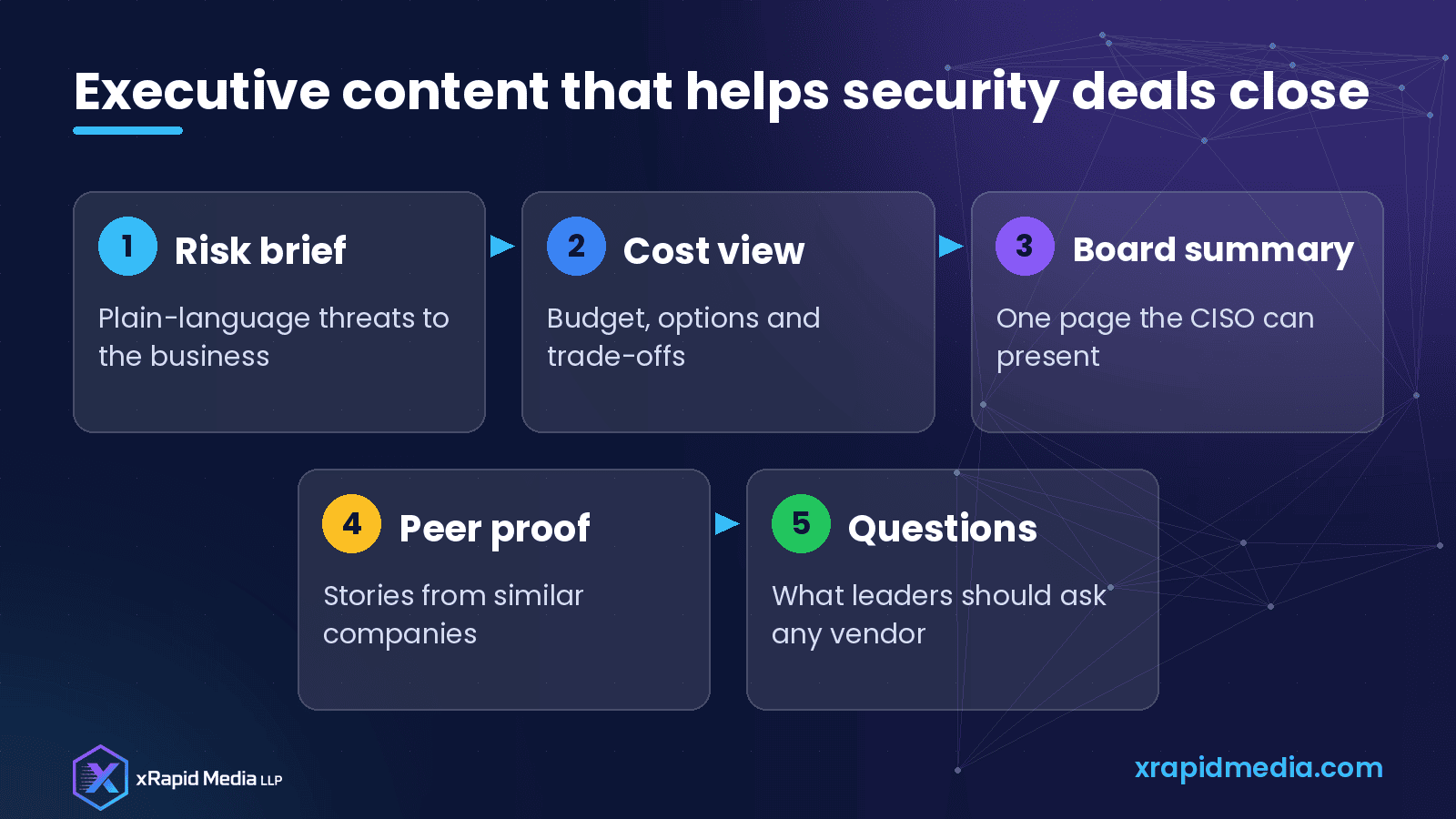
Content formats that work for executives
A plain-language risk brief
A short document, two pages at most, that explains the main threats facing companies in a specific industry and what they could mean for operations, customers and finances. Use publicly available information and cite your sources. Never invent breach costs or statistics.
A cost and options view
CFOs appreciate seeing alternatives laid out honestly: building in-house, buying tools, using a managed service or a mix. Explain the trade-offs in staffing, time and ongoing cost. This positions your offer as a reasoned choice rather than a sales pitch.
A board-ready summary template
One of the most valuable assets you can give a champion is a one-page summary they can adapt and present. Include the problem, the proposed approach, expected benefits, cost and how progress will be reported. You are making their internal job easier, which makes your deal easier.
Peer stories
Executives listen to people like them. Case studies and short interviews that feature a CFO, COO or CEO describing why they invested, and what changed, carry more weight than a technical testimonial alone.
Questions to ask any security vendor
A neutral list of questions business leaders should ask when evaluating security providers shows confidence and helps buyers feel in control. Make sure your own answers are strong.
Deliver content through your champion
Executives rarely download vendor whitepapers. Most executive content reaches them through the CISO or IT leader who is sponsoring the purchase. That means:
- Sales teams should know these assets exist and when to share them.
- Assets should be easy to forward, edit and brand for internal use where appropriate.
- Your champion should be able to present them without needing your team in the room.
Ask champions directly what questions their CFO or board usually asks. Their answers are the best brief you will get for new content.
Use executive content in demand generation too
Some executive content works earlier in the funnel. Industry risk briefs, events or roundtables for finance and operations leaders, and short articles on topics like cyber insurance requirements or security questions from customers can attract business leaders who are starting to think about security. Make sure any claims are accurate and sourced.
Conclusion
Security purchases are business decisions, and the people who make the final call need content written for them. Understand what each executive cares about, translate features into outcomes, offer formats such as risk briefs, cost views and board-ready summaries, and deliver them through your champion. Deals move faster when everyone at the table can see why the investment makes sense.
If you want help building content and campaigns that reach the full security buying committee, book a free B2B marketing consultation with xRapid Media LLP.
About xRapid Media
xRapid Media LLP is a High Tech B2B Marketing company for technology businesses: software and SaaS companies, IT services and managed service providers, and hardware and IT product vendors. Our team combines positioning and content, account-based marketing, paid ads funnels, verified B2B data, intent signals, email and LinkedIn outreach and appointment setting to help you reach the right buyers and turn their attention into qualified leads and meetings.
Want help putting ideas like these into practice? Email [email protected] or book a time with our team.