
Most B2B buyers in tech can spot a “personalized” cold email from the first line. It mentions their recent funding round, compliments a LinkedIn post they barely remember writing and then pivots into a generic pitch. The personalization is there, but it does not connect to anything the buyer cares about.
AI has made this kind of email very cheap to produce. It has also made genuinely relevant outreach much easier, if you use it for the right parts of the job. Our team at xRapid Media LLP, a High Tech B2B Marketing company, runs outbound programs for software, SaaS, IT services and hardware companies, and the question we get most often is simple: what should AI do, and what should people still write?
Here is the split we recommend.
Let AI do the research legwork
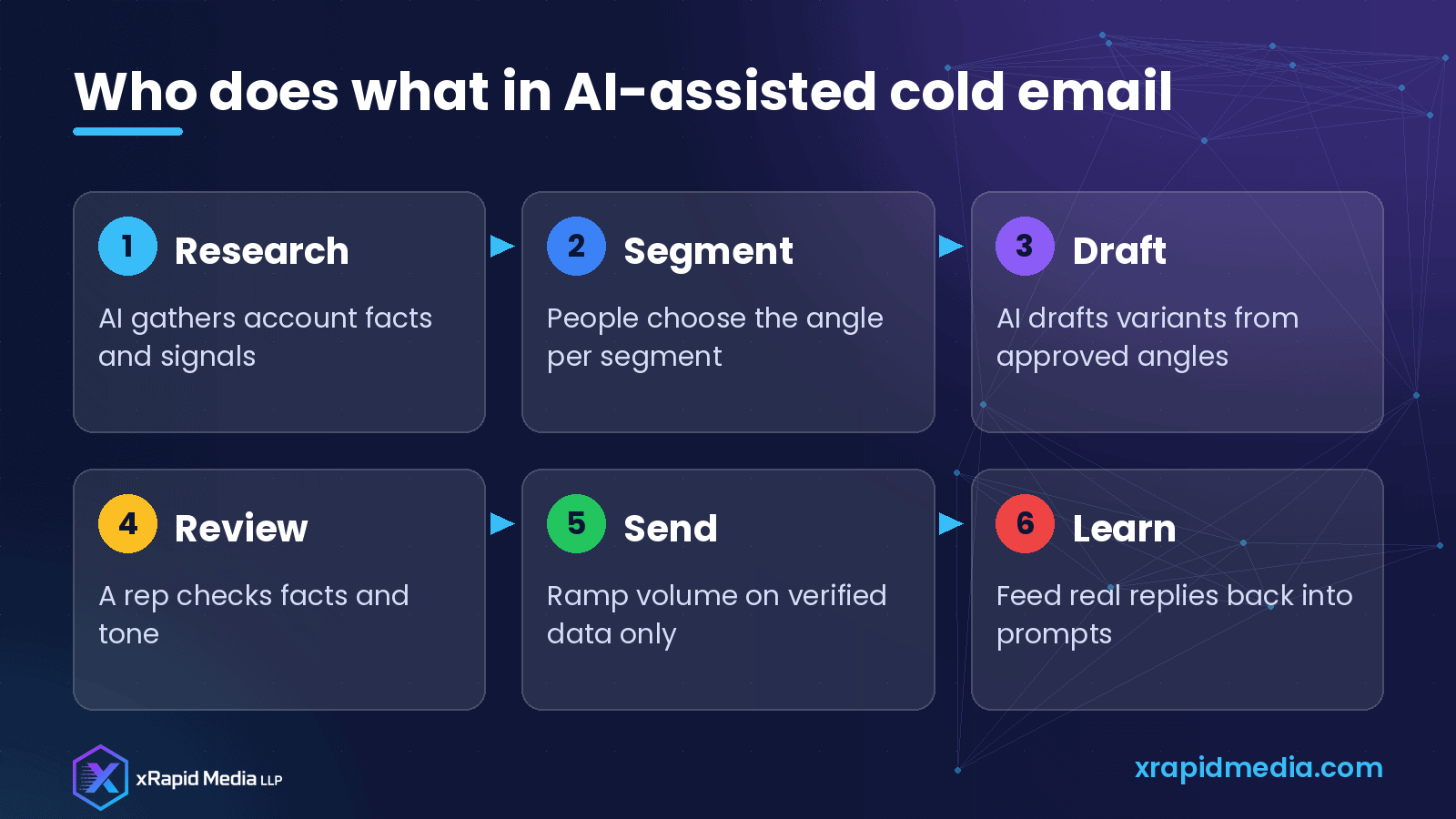
Research is where AI saves the most time with the least risk. Before a rep writes a word, an AI assistant can pull together the basics for each account:
- What the company sells and who it sells to, in plain language.
- Recent public signals, such as new product launches, hiring for specific roles or expansion into new regions.
- The likely tech stack, where it is visible from job posts or public documentation.
- The buyer’s role and the problems people in that role typically own.
Treat this output as notes, not facts. Ask the tool to include the source for each point so a rep can click through and confirm it. A wrong “congratulations on your Series B” is worse than no personalization at all.
Keep the angle a human decision
The angle is the reason this email is worth reading: the specific problem you believe this type of company has, and why your product or service is relevant now. AI is good at generating options, but the choice should come from people who understand your customers.
A practical approach is to define angles at the segment level rather than the individual level. For example, an IT services firm might have three angles:
- Mid-sized companies hiring their first internal IT manager, who often need help with projects the new hire cannot cover alone.
- Companies opening new offices, which need networking, devices and security set up quickly.
- Companies whose job posts mention a cloud migration, which may need extra hands for the move.
Your team writes and approves these angles once. AI then applies the right angle to each account based on the research. That keeps the message grounded in real experience instead of whatever the model guesses sounds compelling.
Let AI draft, but from your raw material
Once the angle is chosen, AI is useful for drafting. The quality of the draft depends almost entirely on what you give it. Feed it:
- The approved angle and the account notes.
- Two or three real emails from your team that got positive replies.
- A short list of rules, such as “no more than 120 words,” “one question at the end” and “no claims about results unless they come from our approved case studies.”
- Phrases to avoid, including the stock openers buyers have learned to ignore.
Ask for two or three variants rather than one. Reps can pick the closest and edit it, which is faster than rewriting a single weak draft.
Where people should still write
Some parts of an email carry too much weight to hand over completely.
The first line
The opening sentence decides whether the rest is read. AI can suggest options, but a rep should pick or rewrite it so it reflects a genuine observation about the account and leads naturally into the angle.
Any claim about results
If your email mentions outcomes, such as faster deployment or fewer support tickets, those claims must come from real customer stories you are allowed to share. Never let a model fill in numbers. It will happily invent a percentage that sounds plausible.
Replies
When a prospect responds, a person should answer. Replies are where trust is built or lost, and buyers notice instantly when a follow-up ignores what they actually said.
Protect your data and your domain
AI makes it easy to send more email, which can create problems if your foundations are weak.
- Start from verified contact data. Personalization does not help if the email bounces or reaches someone who left the company.
- Ramp sending volume gradually and keep authentication (SPF, DKIM and DMARC) in place.
- Watch reply rates by angle, not just open rates. If an angle produces irritated replies, retire it.
- Check what data you are pasting into AI tools and make sure it fits your company’s privacy and security policies.
Build a feedback loop
The real advantage of AI-assisted outreach is how quickly you can learn. Every week, review a sample of sent emails alongside the replies they produced. Look for patterns:
- Which angles lead to meetings, and which only lead to polite “not now” responses?
- Which research points made a difference, and which were ignored?
- Where did reps have to rewrite most of the draft?
Update your prompts, angles and examples based on what you find. Over a few months, the drafts get closer to what your best reps would write themselves.
A simple weekly rhythm
For teams just starting out, we suggest a light routine:
- Monday: refresh account lists and run AI research on new accounts.
- Tuesday: reps review research, assign angles and approve drafts.
- Wednesday to Thursday: send in small batches and handle replies personally.
- Friday: review replies and adjust angles, prompts and examples.
This keeps volume manageable and ensures someone is accountable for every message that goes out.
Conclusion
AI is excellent at the research and first-draft work that used to eat a rep’s day. It is not a substitute for knowing your buyers, choosing a relevant angle or answering a real person who took the time to reply. Split the work deliberately, start from verified data and keep learning from the replies, and your outreach will feel more relevant even as it scales.
If you want help building an AI-assisted outbound program that books real meetings with technology buyers, book a free B2B marketing consultation with xRapid Media LLP.
About xRapid Media
xRapid Media LLP is a High Tech B2B Marketing company for technology businesses: software and SaaS companies, IT services and managed service providers, and hardware and IT product vendors. Our team combines positioning and content, account-based marketing, paid ads funnels, verified B2B data, intent signals, email and LinkedIn outreach and appointment setting to help you reach the right buyers and turn their attention into qualified leads and meetings.
Want help putting ideas like these into practice? Email [email protected] or book a time with our team.