
For an early-stage B2B startup, outbound is tempting. You have a product, a rough idea of who should buy it and a list-building tool that promises thousands of contacts. Load the list, write a sequence, send it and see what happens.
The problem is that many B2B startups sell into a limited market. There may only be a few thousand companies that genuinely fit, and only a handful of decision-makers at each. If you blast an untested message to all of them, you do not just get poor results. You teach your best prospects to ignore you, damage your sending domain and lose the chance to make a strong first impression later, when your message is sharper.
Our team at xRapid Media LLP works with startups and growing tech companies on outbound, verified data and lead generation. Here is how we help founders run outbound as a series of small experiments instead of one big gamble.
Treat outbound as research first
In the early days, the main goal of outbound is learning, not volume. Each campaign should answer a question:
- Does this segment recognize the problem we solve?
- Which job title actually owns the problem?
- Which way of describing our value gets a response?
- What objections come up most often?
Meetings are a great outcome, but even a thoughtful “not right now, because…” reply is valuable data.
Write a clear hypothesis
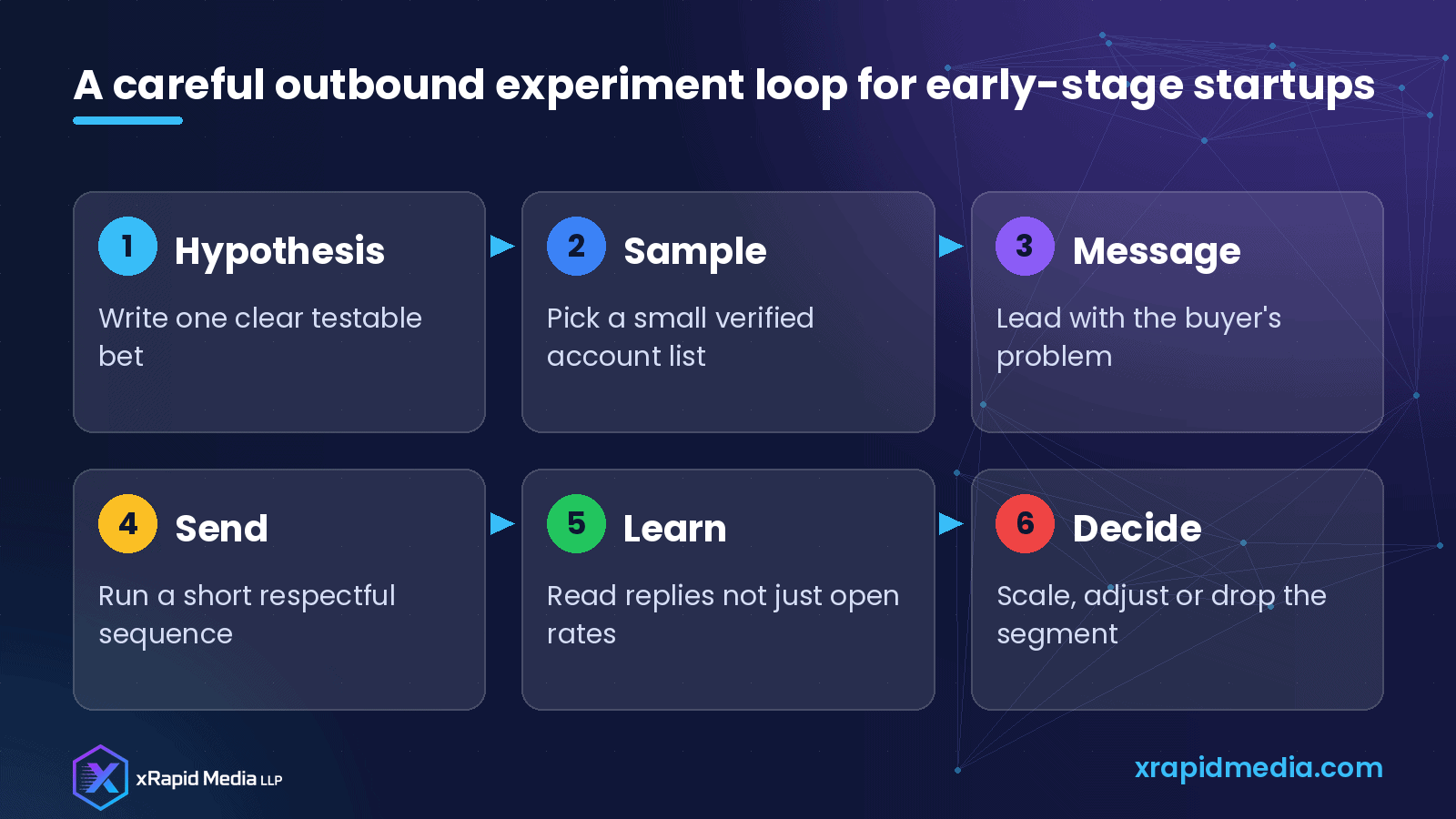
Before sending anything, write down one testable bet. For example: “Operations managers at mid-sized logistics software companies struggle with manual customer onboarding and will respond to a message about cutting onboarding time.” That sentence names a segment, a role, a problem and an angle.
If a campaign has no hypothesis, you cannot tell whether it worked or why. Vague campaigns produce vague lessons.
Use a small, verified sample
Start with a small list, perhaps 50 to 100 accounts that match your hypothesis closely. That is enough to see patterns without burning the segment. Verify contact details before sending, because bounces hurt your domain reputation and waste the sample.
Keep the remaining accounts in that segment untouched. If the experiment works, you can expand with a refined message. If it fails, you have not used up the market.
Protect your primary domain as well. Make sure email authentication is set up correctly, warm up new sending addresses gradually and keep daily volumes modest.
Lead with the buyer’s problem
Early outbound often fails because it describes the product instead of the problem. A founder naturally wants to explain features. A busy buyer only cares whether you understand something they are struggling with.
A stronger message structure:
- A short observation relevant to their role or company.
- The problem you think they may have, stated plainly.
- A brief note on how you help, without jargon.
- A low-pressure question, such as whether the problem is a priority this quarter.
Keep it short and human. A message from a founder who clearly researched the account often outperforms polished automation.
Run a short, respectful sequence
Three or four touches over a couple of weeks is usually enough for an experiment. Mix channels where it makes sense: an email, a LinkedIn connection with a short note and a follow-up email that adds something useful, like a relevant article or insight. Avoid aggressive cadences and fake “just bumping this” messages.
If someone asks you to stop, stop immediately and mark them so no one on your team contacts them again.
Read the replies, not just the metrics
Open rates are unreliable and tell you little about whether your message resonated. Focus on:
- Positive replies and meetings booked.
- Thoughtful negative replies that explain why.
- Referrals to a different person, which tell you about role ownership.
- Patterns in objections across the sample.
Read every reply yourself in the early stages. A founder’s reading of ten honest replies often teaches more than a dashboard of hundreds of opens.
Decide what to do next
After each experiment, make a clear decision:
- Scale if the segment and message produced meetings with good-fit buyers.
- Adjust if replies show interest but point to a different role, problem or angle.
- Drop if the segment does not recognize the problem at all.
Record the result in a simple experiment log: hypothesis, sample, message, outcomes and decision. Over a few months, this log becomes the foundation of your ideal customer profile and your first sales playbook.
A practical example
Imagine a startup selling compliance automation for small software companies. Its first experiment targets CTOs and gets few replies. Several responses say the head of operations owns compliance. The team adjusts the hypothesis, tests a smaller sample of operations leaders with a message about preparing for customer security questionnaires and sees better conversations. It then expands carefully within that segment.
Conclusion
Outbound for an early-stage B2B startup works best as careful research. Write a hypothesis, test with small verified samples, lead with the buyer’s problem, read the replies and decide deliberately. You will learn faster and keep your market intact for when your message is ready.
If you want help building outbound programs and verified data for your startup, book a free B2B marketing consultation with xRapid Media LLP.
About xRapid Media
xRapid Media LLP is a High Tech B2B Marketing company for technology businesses: software and SaaS companies, IT services and managed service providers, and hardware and IT product vendors. Our team combines positioning and content, account-based marketing, paid ads funnels, verified B2B data, intent signals, email and LinkedIn outreach and appointment setting to help you reach the right buyers and turn their attention into qualified leads and meetings.
Want help putting ideas like these into practice? Email [email protected] or book a time with our team.