

For many cloud and DevOps companies, getting listed on a major cloud marketplace feels like a milestone. The listing goes live, the announcement goes out, and then not much happens. The marketplace is a storefront, not a demand generator. Buyers rarely browse it the way consumers browse an app store, and a listing nobody is pointed to sits quietly.
That does not mean marketplaces are not worth it. For some buyers, purchasing through their existing cloud provider simplifies procurement and billing, and in some cases can count toward spending commitments they already have with that provider. When your sales and marketing teams know how to use that, the marketplace can remove friction from deals that would otherwise stall in procurement.
Our team at xRapid Media LLP helps cloud, DevOps and SaaS vendors build demand generation and partner programs. Here is how we approach marketplace listings so they contribute to real pipeline.
Start by confirming why buyers would use it
Before investing heavily, talk to customers and active prospects. Ask how they prefer to buy software, whether procurement favors purchasing through their cloud provider and whether they have committed cloud spend they want to apply. The answers vary widely by company size and industry.
If your best-fit buyers are large organizations with established cloud agreements, marketplace purchasing may matter a great deal. If they are smaller teams buying with a credit card, it may matter less. Let that evidence set your level of investment.
Write the listing for the evaluator, not the algorithm
Many marketplace listings are copied straight from a homepage. That is a missed opportunity. The person reading your listing is often a technical evaluator or a procurement contact already partway through a decision. They want:
- A clear one-paragraph description of what the product does and for whom.
- Supported deployment models and the cloud services it integrates with.
- Pricing structure, or a clear note that private offers are available.
- Links to documentation, architecture diagrams and security information.
- Support details and how to start a trial or proof of concept.
Keep the language concrete. “Automated drift detection for infrastructure as code across multiple accounts” helps an evaluator. “The ultimate cloud platform” does not.
Align sales on how marketplace deals work
Marketplace deals often break down because sales does not understand the mechanics. Reps should know how to propose purchasing through the marketplace, how private offers work for custom pricing and terms, and who internally sets them up.
Build a short internal playbook: when to suggest marketplace purchasing, what to say to procurement, the steps to create an offer and how commission or attribution is handled. When reps are comfortable, they can bring up the option early in deals where procurement is likely to slow things down.
Drive traffic from your own channels
Do not wait for marketplace browsing to find you. Point buyers to the listing from:
- Your pricing page, with a short note like “Also available through your cloud marketplace.”
- Sales emails and proposals for accounts that buy through their cloud provider.
- Account-based campaigns aimed at organizations with known cloud commitments.
- Webinars and technical content, where a marketplace link offers a low-friction next step.
This matters because many buyers will only discover the marketplace option if you tell them about it.
Build relationships with the cloud provider’s teams
Cloud providers have partner and field sales teams whose interests can align with yours when your product drives consumption on their platform. Relationships take time, but they can lead to co-selling and co-marketing opportunities.
Make it easy for partner contacts to understand and recommend you. Create a short partner brief that explains which customer problems you solve, which of the provider’s services you work with and an example customer scenario. Share wins and joint customer stories when customers give permission.
Run co-marketing that buyers find useful
Joint webinars, workshops and solution guides with a cloud provider or adjacent partners can lend credibility. Keep them practical. A workshop that walks attendees through a real deployment pattern, followed by an offer to start through the marketplace, tends to produce more qualified interest than a generic joint announcement.
Measure sourced and influenced pipeline
Track two things separately: deals that originated through the marketplace or cloud partner introductions, and deals that closed through the marketplace after starting elsewhere. The second group often reveals the real value, which is shorter procurement and fewer stalled deals.
Also watch time to close for marketplace deals compared with direct ones, and listing page traffic sources. Review every quarter and adjust your investment based on what the data shows.
Conclusion
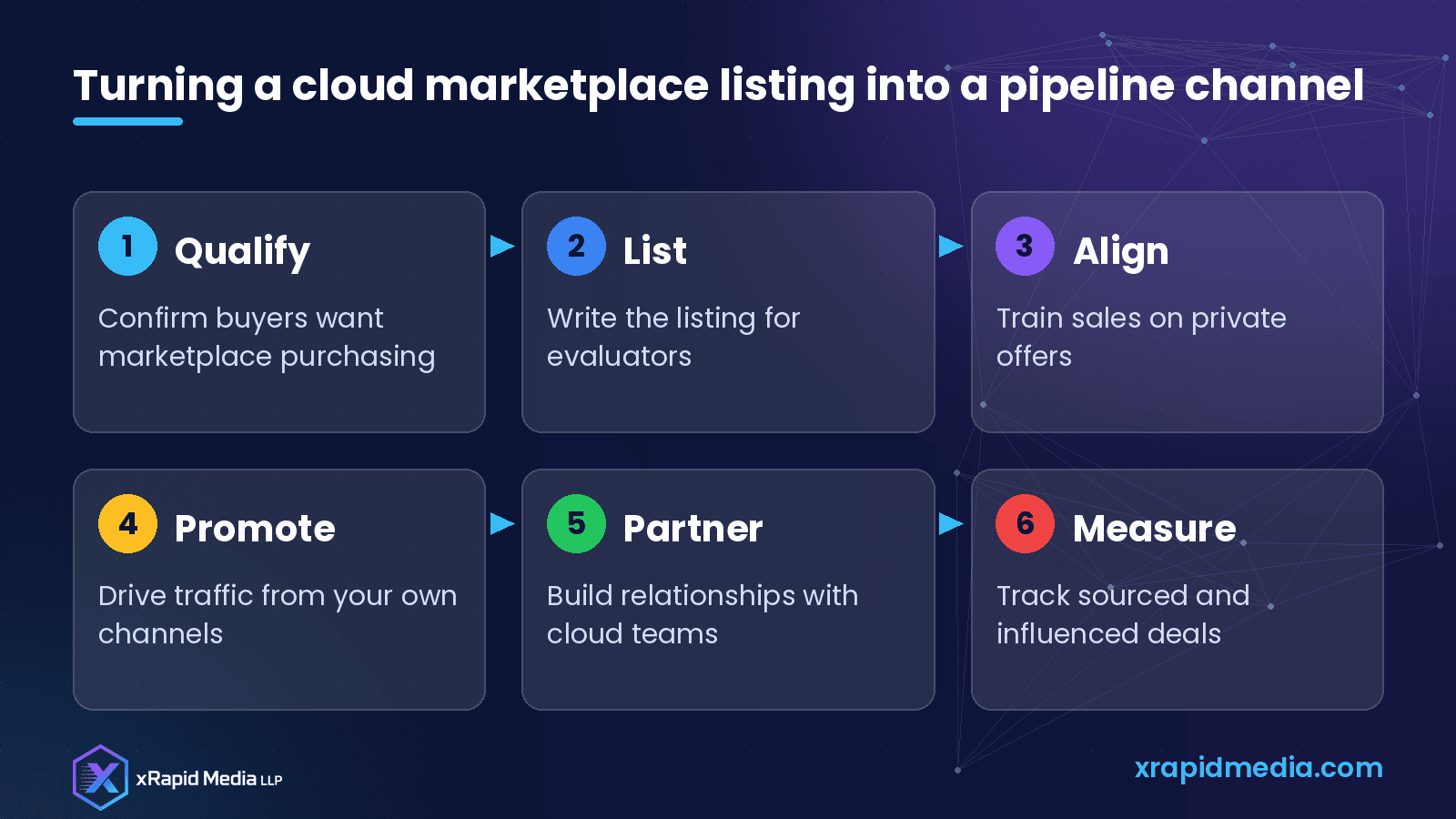
A cloud marketplace listing is a storefront, not a strategy. Confirm buyers want to purchase that way, write the listing for evaluators, train sales on private offers, drive your own traffic to it, build partner relationships and measure real pipeline.
If you want help building demand generation and partner marketing for your cloud or DevOps product, book a free B2B marketing consultation with xRapid Media LLP.
About xRapid Media
xRapid Media LLP is a High Tech B2B Marketing company for technology businesses: software and SaaS companies, IT services and managed service providers, and hardware and IT product vendors. Our team combines positioning and content, account-based marketing, paid ads funnels, verified B2B data, intent signals, email and LinkedIn outreach and appointment setting to help you reach the right buyers and turn their attention into qualified leads and meetings.
Want help putting ideas like these into practice? Email [email protected] or book a time with our team.