
Few B2B marketing debates go around in circles like gating. One camp says every whitepaper, report and webinar should sit behind a form, because that is how you generate leads. The other says forms kill reach and buyers hate them, so everything should be open. Both camps have a point, and both can hurt a tech company when followed blindly.
The better question is not “Should we gate?” but “What does this asset need to do, and what does the buyer get in exchange for their details?”
Our team at xRapid Media LLP runs content and demand generation programs for software, SaaS, IT services and hardware companies. Here is the framework we use to decide what to gate and what to give away.
Why gating everything backfires
When every useful asset requires a form, a few things tend to happen:
- Buyers fill in fake details or a personal email, which pollutes your CRM.
- Early-stage researchers leave rather than share information they are not ready to give.
- Sales follows up on downloads that were really just curiosity, and buyers learn to avoid your forms.
- Search engines and AI assistants cannot read gated content, so it does nothing for visibility.
Marketing reports a healthy lead count, sales reports that the leads are weak, and the two teams argue about definitions instead of pipeline.
Why gating nothing can also hurt
Open content builds reach and trust, but it can leave you blind. If you have no way to know which accounts engage with your best material, sales has fewer signals to act on. And some assets genuinely deserve an exchange because they take significant effort to produce and are mostly useful to serious buyers.
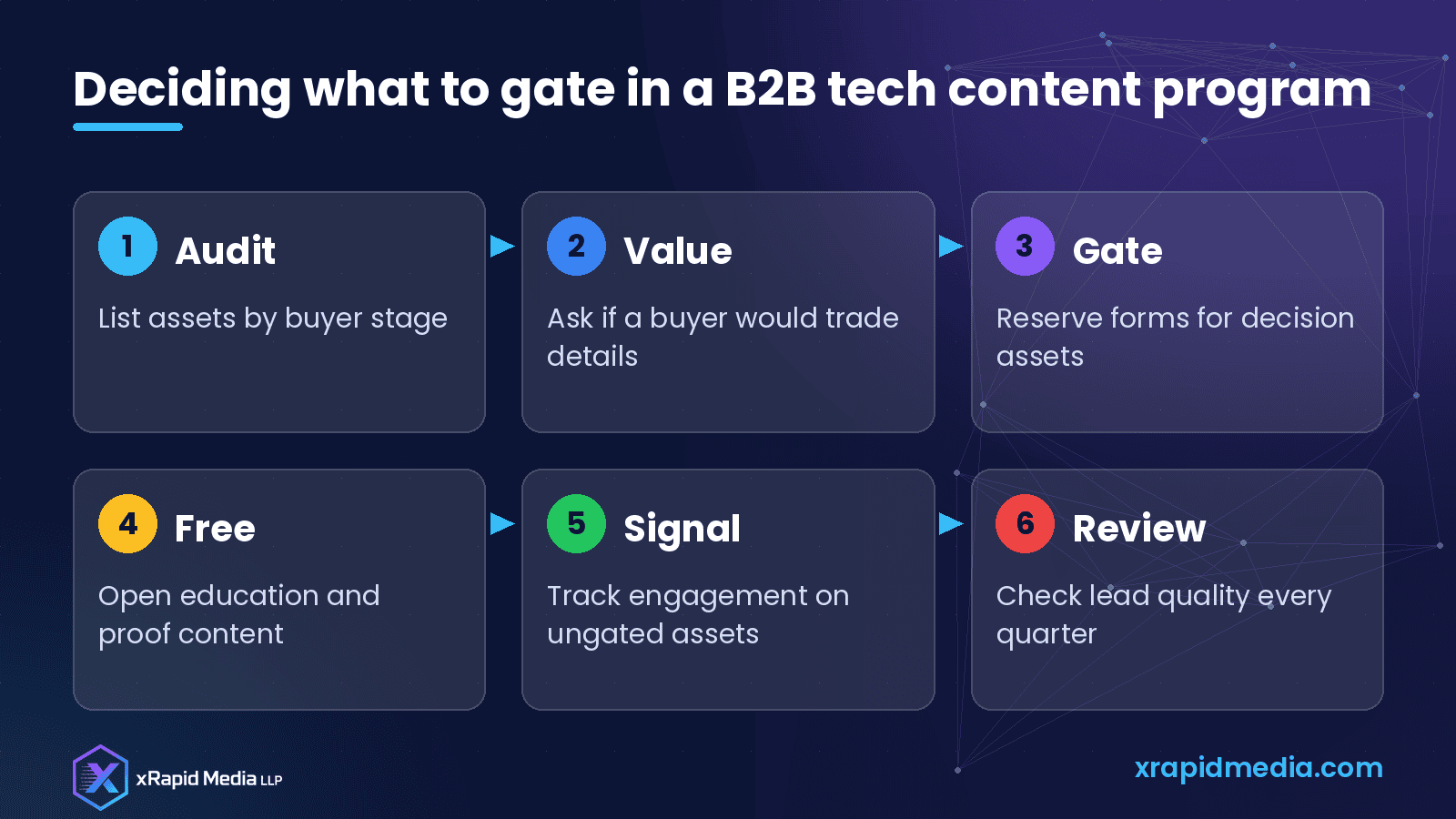
A simple test: would a serious buyer trade details for this?
For each asset, ask honestly whether a buyer actively evaluating solutions would happily give their work email to get it. Assets that often pass:
- Original research with data you collected yourself.
- Detailed implementation or migration planning templates.
- Interactive assessments that produce a tailored result.
- Pricing or ROI worksheets used during internal business cases.
- Live workshops with time for specific questions.
Assets that usually fail: blog posts, short guides, product overviews, basic checklists and recorded webinars that summarize public information. Gating these mostly creates friction.
Map content to buyer stage
A practical rule is to keep early-stage education open and reserve gates for later-stage assets.
Open: educational articles, explainer videos, use-case pages, case studies and technical documentation. These earn trust and visibility.
Lightly gated: templates, toolkits and in-depth guides. Keep forms short, ask only what you will use, and consider allowing the first part to be read openly.
Gated with intent questions: assessments, consultations and workshops. Here you can ask one or two qualifying questions, such as current tools or project timeline, because the buyer understands why you are asking.
Get signals from ungated content
Ungated does not mean invisible. You can still learn a lot:
- Track which known contacts and accounts engage with key pages through your marketing automation and analytics, within your privacy policy.
- Use reputable intent data to see which target accounts research topics your content covers.
- Add soft calls to action inside open content, such as “Get the editable template” or “Book a 20-minute review.”
- Watch for repeat visits to pricing, integration and security pages after content consumption.
These signals often tell sales more than a single form fill on a gated ebook.
Treat downloads as interest, not readiness
When someone does fill a form, do not hand them straight to a rep as a sales-ready lead. A download is a signal of interest in a topic. Combine it with fit and behavior before routing:
- Is the company in your ideal customer profile?
- Is the role involved in buying decisions?
- Has the account shown other signs of evaluation?
High-fit, high-intent contacts can go to sales quickly. Others belong in a nurture sequence with genuinely useful follow-up content. This protects your reps’ time and your brand.
A practical example
Consider a cybersecurity software company with a library of twenty assets, all gated. After an audit, the team ungates its blog-style guides and case studies, keeps a detailed incident response planning template behind a short form, and turns an annual survey report into a gated asset with an open executive summary. It then adds a short security posture assessment with two qualifying questions.
The likely result is fewer form fills overall but clearer signals: people who request the template or take the assessment are telling you something specific. That is the trade most B2B tech teams should want.
Review quality, not volume
Every quarter, look at each gated asset and ask: how many of these leads became meetings, opportunities or customers? If a gate produces volume but no pipeline, open it up. If an ungated asset shows up repeatedly in closed-won journeys, consider building a deeper companion piece worth gating.
Conclusion
Gate the assets serious buyers would gladly trade details for, keep education and proof open, gather signals from ungated engagement and qualify downloads before sales follows up. The goal is trust and pipeline, not a bigger lead count.
If you want help building a content program that generates qualified B2B leads instead of form-fill noise, book a free B2B marketing consultation with xRapid Media LLP.
About xRapid Media
xRapid Media LLP is a High Tech B2B Marketing company for technology businesses: software and SaaS companies, IT services and managed service providers, and hardware and IT product vendors. Our team combines positioning and content, account-based marketing, paid ads funnels, verified B2B data, intent signals, email and LinkedIn outreach and appointment setting to help you reach the right buyers and turn their attention into qualified leads and meetings.
Want help putting ideas like these into practice? Email [email protected] or book a time with our team.