

Datasheets win engineers’ trust. They rarely win budget on their own. IoT and edge hardware purchases usually need a facility manager, an operations lead, an IT or OT stakeholder and someone from finance to agree. Content marketing has to translate radio specs, IP ratings and compute options into stories those people can share.
Our team works with hardware and mixed hardware-software vendors who sell to business buyers. The content that performs treats specs as evidence inside a narrative, not as the narrative itself.
Know the dual audience
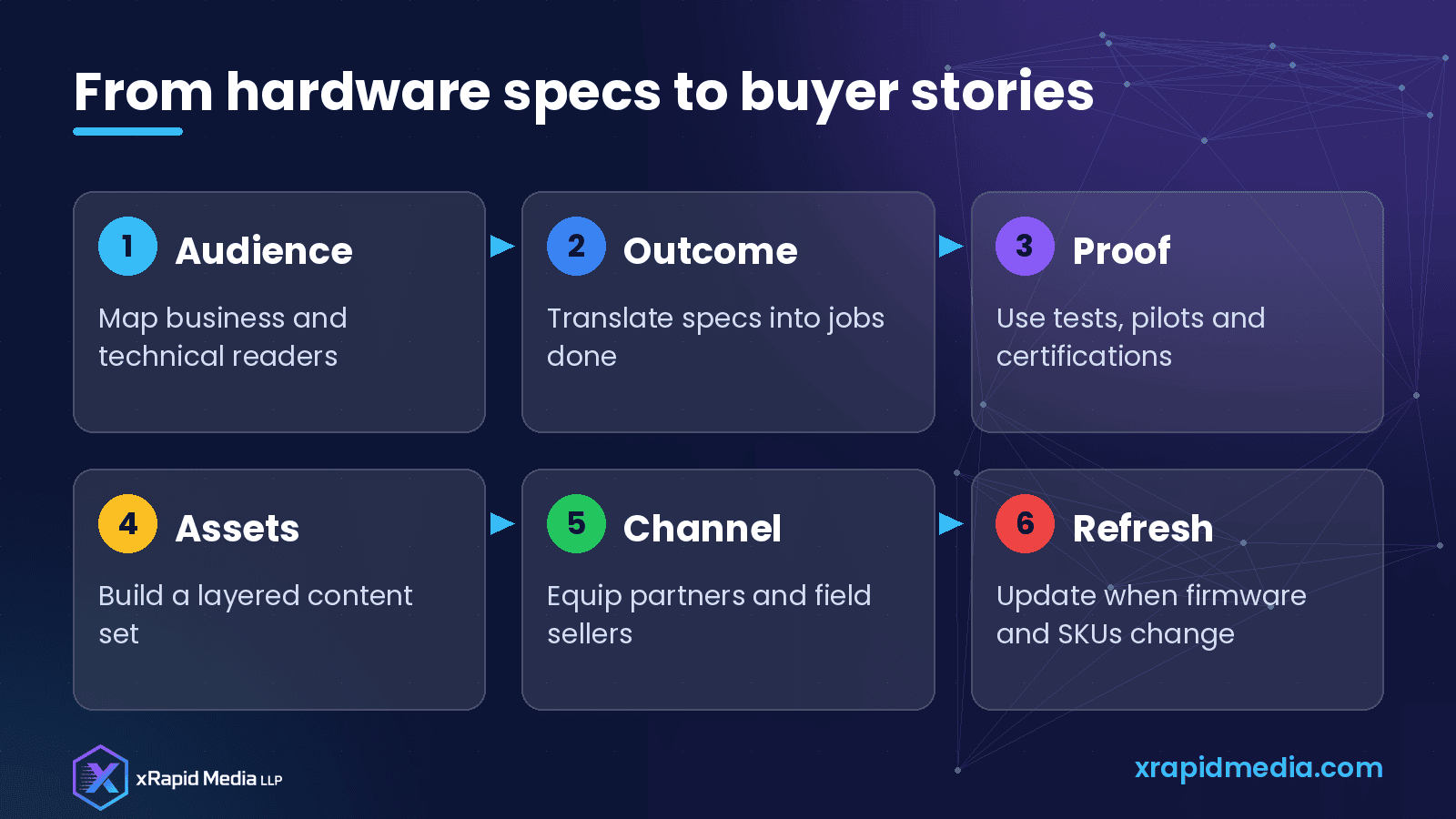
Technical readers want architectures, limits, environmental ratings, management protocols and integration paths. Business readers want uptime, safety, labor savings, compliance support and total cost across install, connectivity and maintenance. Good programs give both groups a path without forcing one to wade through the other’s entire library.
Create a simple persona map for each major use case: who feels the pain, who signs, who blocks and what each fears about a wrong choice.
Lead with the job, then show the spec
“IP67” is a spec. “Keeps running on a washdown line” is a job story. “Wide temperature range” becomes “survives unconditioned edge closets.” “Local inference” becomes “keeps inspecting widgets when the WAN drops.”
A reliable pattern for a page or article:
- The operating problem in the buyer’s words
- Why older approaches fail in that environment
- How the device or gateway fits the workflow
- The specs that make the claim believable
- Integration and management notes for IT/OT
- Proof from a pilot, certification or customer story
Never invent performance numbers. If you only have lab results, label them as lab results.
Build a layered asset system
Think in layers:
- One-pagers for business stakeholders
- Deep deployment guides for engineers
- Short videos of install and day-in-the-life use
- Comparison sheets against status quo (not insult-driven rival attacks)
- ROI worksheets sales can defend
- Security and compliance packets for reviews
Host them in a structure that matches how buyers search: by industry, by use case and by product family. Make sure partners and distributors get the same kit with clear usage rules.
Tell installation and lifecycle stories
Hardware content often stops at unboxing. Buyers also worry about mounting, power, connectivity, fleet updates, spares and end-of-life. Articles and videos about provisioning at scale, remote monitoring and firmware update practices reduce fear and shorten evaluations.
If your edge devices work with cloud services, explain what stays local, what goes to the cloud and what happens offline. Ambiguity here stalls security reviews.
Use channels that hardware buyers trust
Besides your site and LinkedIn, consider trade publications, industry associations, webinars with systems integrators, distributor newsletters and conference demos that show live conditions when possible. Enable sales engineers with talk tracks that match the public content so the story does not fork.
User communities and integrator forums can amplify honest how-tos. Participate by helping, not by dropping datasheet PDFs into every thread.
Proof without hype
Useful proof includes third-party certifications, named test methods, pilot designs, anonymized performance ranges and customer quotes you have permission to use. Avoid absolute claims like “never fails” or unverifiable market leadership lines.
When sharing battery life, range or throughput, state the conditions. Serious buyers will ask anyway.
Measure content against the hardware funnel
Watch which assets appear in opportunity records, which pages precede evaluation kit requests and which guides partners actually send. Kit requests, sample orders and pilot agreements are often better success metrics than raw traffic.
Ask field teams monthly which objections still lack a good asset. That backlog is your editorial calendar.
Common mistakes
- Publishing only SEO blogs that never mention deployment reality
- Hiding all specs behind forms so engineers bounce
- Using consumer gadget tone for industrial buyers
- Letting product SKUs change while content still shows old photos and part numbers
- Ignoring integrator enablement
A ninety-day content plan
Month one: interview sales engineers and three customers, inventory outdated assets, pick two use cases. Month two: ship a business one-pager, a technical deployment guide and one video per use case. Month three: build a partner kit, add a comparison-to-status-quo page and wire asset tracking into the CRM.
IoT and edge hardware marketing succeeds when every bold claim can point to a spec, a test or a real deployment story. That discipline turns catalogs into conversations.
Partner and distributor storytelling
Systems integrators and distributors often tell your story when you are not in the room. Give them a short narrative deck, approved photos, objection answers and a clear escalation path for tough technical questions. When partners improvise without materials, specs get overstated and trust suffers later in procurement.
If you want help turning hardware capabilities into B2B content, partner kits and demand programs, xRapid Media LLP works with technology and hardware vendors on exactly that. Book a free B2B marketing consultation and we can review your current asset set.
About xRapid Media
xRapid Media LLP is a High Tech B2B Marketing company for technology businesses: software and SaaS companies, IT services and managed service providers, and hardware and IT product vendors. Our team combines positioning and content, account-based marketing, paid ads funnels, verified B2B data, intent signals, email and LinkedIn outreach and appointment setting to help you reach the right buyers and turn their attention into qualified leads and meetings.
Want help putting ideas like these into practice? Email [email protected] or book a time with our team.