
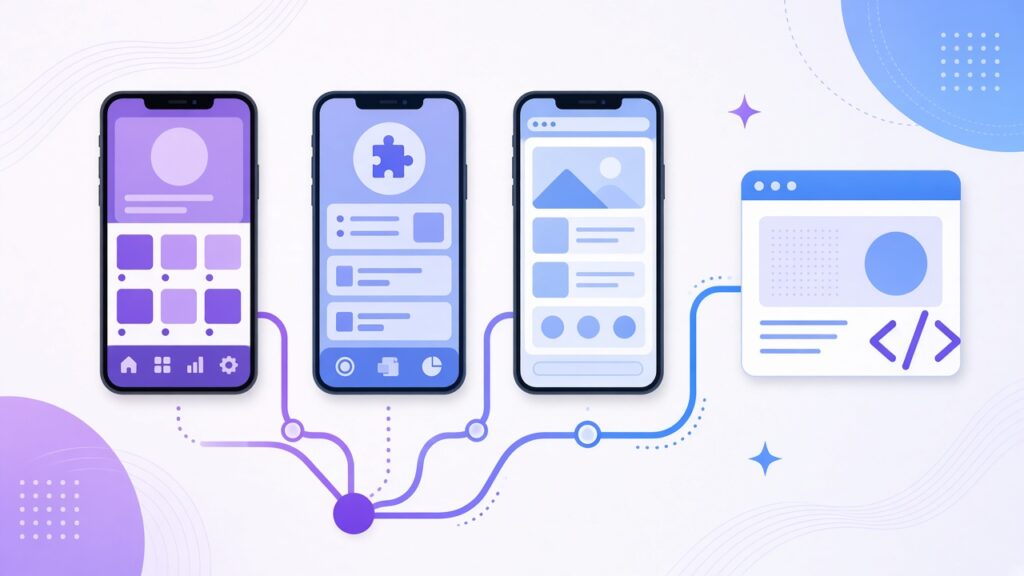
Once a business decides it wants an app, one of the first questions we hear is, “How should we build it?” There are three main paths: native apps, cross-platform apps and progressive web apps, often called PWAs. Each one can be the right answer. Each can also be the wrong one, depending on what your app needs to do, who uses it and how much you want to spend.
Here’s how our team explains the options to clients, without the jargon.
Native apps
A native app is built specifically for one platform using that platform’s own tools. For iPhones and iPads that usually means Swift, and for Android it usually means Kotlin. If you want both, you build and maintain two separate apps.
Where native shines:
- The smoothest performance and animations
- Full, immediate access to device features like the camera, Bluetooth, sensors and background processing
- An interface that feels completely at home on each platform
The trade-offs: Two codebases mean more development time, more testing and more ongoing maintenance. Every new feature has to be built twice.
Native tends to make sense for apps where performance is central, such as games, heavy media editing, advanced hardware integrations, or products where the app itself is the core business.
Cross-platform apps
Cross-platform frameworks like Flutter and React Native let developers write most of the code once and ship it to both iOS and Android. The result is still a real app you download from the App Store or Google Play.
Where cross-platform shines:
- One main codebase for both platforms, which usually means lower cost and faster delivery
- Performance that’s more than good enough for the vast majority of business apps
- Easier to keep features consistent across devices
The trade-offs: Some advanced device features may need extra platform-specific work. You’re also relying on the framework keeping pace with Apple and Google updates, although the major frameworks are well supported.
For most of the business apps we see, such as booking apps, ordering apps, customer portals, loyalty programmes and internal tools, cross-platform is often the practical sweet spot.
Progressive web apps
A PWA is a website built to behave like an app. Users open it in a browser and can add it to their home screen. It can work offline to a degree, load quickly and, on many devices, send notifications.
Where PWAs shine:
- No app store approval needed, and updates go live instantly
- One build works across phones, tablets and computers
- Usually the lowest cost to build and maintain
- Easy to share with a simple link
The trade-offs: Access to device features is more limited than a native or cross-platform app, and support for some capabilities varies between platforms and browsers. You also miss out on discovery through app store search, which matters for some products more than others.
PWAs work well for content-driven tools, simple ordering or booking flows, dashboards and early versions of an idea you want to test quickly.
Questions to ask before you decide
Rather than starting with technology, we start with a handful of questions:
- What must the app do on day one? List the essential features and note any that rely on device hardware.
- Who are your users? If most of your customers use Android, or most use iPhones, that shapes priorities.
- Do you need to be in the app stores? For some audiences, an App Store or Play Store listing builds trust. For others it adds friction.
- How often will it change? If you’ll update content and features frequently, easier maintenance becomes valuable.
- What’s your budget for the first year? Include maintenance, hosting and updates, not just the initial build.
A practical example
Imagine a local fitness studio that wants members to view class schedules, book sessions and get reminders. None of that needs heavy device access. A cross-platform app would give them a store presence and push notifications, while a PWA could deliver a lighter version even faster. A native app would likely be more than they need.
Now imagine a company building a tool that connects to a custom Bluetooth device and processes data in the background. That’s where native development, or a cross-platform app with significant native modules, starts to earn its cost.
You can change paths later
Choosing one approach today doesn’t lock you in forever. Many businesses start with a PWA or a focused cross-platform app to test demand, then invest further once they know what users value. The key is building with clean, well-organised code and a solid backend so the app can grow.
Conclusion
There’s no single best way to build an app, only the best fit for your goals, users and budget. Native offers maximum performance, cross-platform offers efficiency for most business needs, and PWAs offer speed and simplicity. Start with what your app truly needs, and let that guide the choice.
Growing an IT business? xRapid Media LLP is a High Tech B2B Marketing company. We help app development companies find and engage the right B2B buyers through data-driven prospecting, verified contact data, account-based campaigns, email and LinkedIn outreach and appointment setting. Call +91 9767196309, email [email protected] or book a free B2B marketing consultation.